
Switchable between Blue Star Split AC and Blue Star Window AC? Don’t be shocked! With the rising temperature and power bills, it’s a matter of concern to choose the right air conditioner. Both are reliable and power-saving, but for other needs.
In this extensive review, we are going to dig deep into every feature — from performance and installation to price, appearance, and smarts — so you can decide which one is the best for your 2026 residence. Before choosing between models, it’s important to understand the core Blue Star AC technologies and features that impact performance and energy savings.
Understanding Blue Star Split vs Window AC
Before we delve into comparisons, it’s essential to understand what makes a Blue Star Split vs Window AC different.
Split Air Conditioners
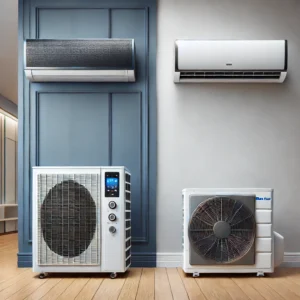
A Split AC has two main units — an indoor unit (installed on your wall) and an outdoor unit (installed outside your home). The compressor is installed in the outdoor unit, while air cooling and distribution are done by the indoor unit.
Blue Star Split ACs provide slim profiles, silent operation, and state-of-the-art inverter technology for effective power usage.
Window Air Conditioners
A Window AC, on the other hand, is a solitary unit that occupies space in your window or in an engineer-designed wall slot. It’s an old-school cooler — simple to fit, simple to operate, and affordable.
Blue Star Window ACs are preferred by people who want effective cooling without going through the travails of having to handle complex installation.
Comparing Blue Star Split vs Window AC
Now, let’s break down the differences and similarities in the Blue Star Split vs Window AC debate.
1. Design and Aesthetics
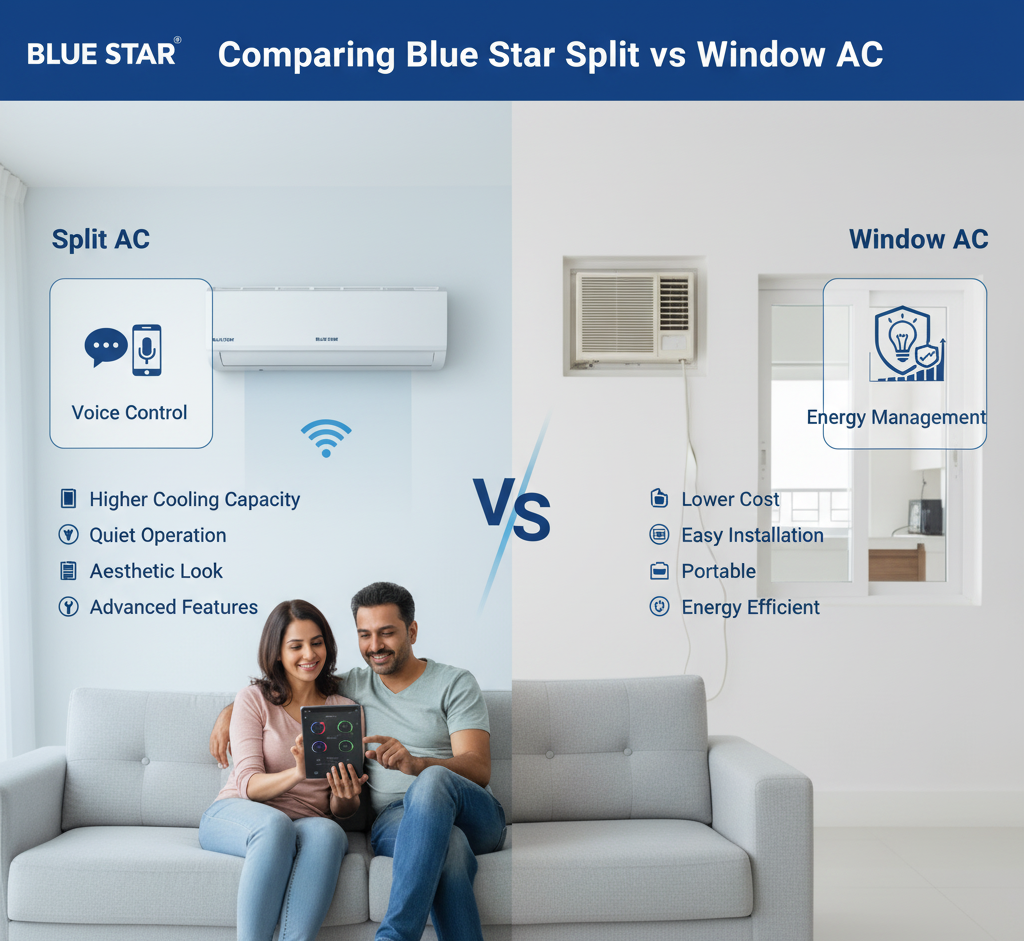
- Split ACs: Fit best to the homes where there is ample wall and outdoor space. The split unit won’t obstruct your window view and offers more flexibility while positioning.
- Window ACs: Fit for single room or flats since there will be an empty window slot. It’s nice as far as space is involved but not that wonderful from an aesthetic point of view.
2. Installation Requirements
Split AC Installation
Split AC installation involves hanging the indoor unit, fitting copper pipes, and mounting the outdoor compressor. The process is done within 2–4 hours and should be carried out by a professional technologist.
Blue Star offers authorized installation service, hence making installation easy and providing high performance in the long term.
Window AC Installation
Window ACs are simpler. Just slide the unit into the window slot, secure it, and you’re ready to go. It’s quick, easy, and cheaper to install — perfect for rented apartments or temporary setups. To know more about installation check out this article 7 Easy Steps for Blue Star AC Installation guide.
3. Cooling Efficiency
Both types are efficient, but there are nuances:
- Split ACs: Split ACs win this round. They distribute air evenly throughout the room using multi-directional swing and wide airflow louvers.
- Window ACs: Window ACs are extremely powerful but vent air in one direction only — ideal for small rooms but not desirable for big rooms.
Ideal Room Size for Each Type
| Room Size | Recommended AC Type |
|---|---|
| Up to 120 sq. ft | Window AC (1 Ton) |
| 120–180 sq. ft | Split AC (1.5 Ton) |
| Above 180 sq. ft | Split AC (2 Ton or higher) |
If your looking ideal ac for your small room, check out our article Blue Star AC Models for Small Rooms
4. Noise Levels
Noise level comes at the forefront of comfort when it comes to air conditioners — particularly if the AC is being used in your bedroom, study, or office. No one will appreciate a constant hum disrupting their sleep or concentration.
Split ACs
Split ACs are designed to be quiet and unobtrusive while they cool. Since the compressor, being the loudest component, is housed outdoors, the indoor unit does not make any or very little noise. Blue Star’s top-of-the-line Split ACs, such as Blue Star 5 Star Inverter Split AC, operate at levels as low as 28–32 decibels (dB) — roughly the same volume level as a whisper inside a library or in a silent room.
This disturbance-free performance is delivered through industry-leading acoustic insulation, brushless DC motors, and precise fan design. The result is a silent environment perfect for sleep, work, or relaxation. Late night cooling or siesta during lunch, Split ACs provide comfort without ambient disturbance.
Window ACs
Window ACs, on the other hand, place everything — compressor, fan, and evaporator — within a single metal box. Due to the confided setup, they are more noisy and generally range between 50–55 dB. This is approximately the volume of the average conversation.
While Blue Star has gone quite far in reducing operation noise by means of increased insulation and compressor vibration management, Window ACs are simply not in a position to keep pace with Split units’ near-silent operation. The airflow and compressor vibration through a limited outlet necessarily render them noisy.
For living rooms, small offices, or rental spaces, the sound might not be a major issue. But if you’re noise-sensitive or want a serene atmosphere in your bedroom or home office, a Blue Star Split AC is the clear winner in terms of quietness and overall comfort.
5. Energy Efficiency
Energy efficiency varies based on models and usage:
- Split ACs: Often come with higher energy efficiency ratings, especially inverter models, leading to potential energy savings.
- Window ACs: Generally have lower energy efficiency ratings but are improving with newer models.
6. Cost Considerations
Initial Cost
| Type | Price Range (2025) |
|---|---|
| Blue Star Split AC (1.5 Ton, 5 Star) | ₹38,000 – ₹55,000 |
| Blue Star Window AC (1.5 Ton, 5 Star) | ₹28,000 – ₹36,000 |
Split ACs are more expensive upfront due to their advanced technology and installation cost.
Long-Term Operating Cost
Split ACs save more on electricity bills, so if you plan to use the AC frequently (say, 8+ hours daily), it becomes more economical over time.
Window ACs are better for occasional use or short summer months.
7.Maintenance and Cleaning
Blue Star Split ACs and Window ACs both need to be cleaned periodically to provide steady cooling and prolong their lifespan. Split ACs, however, tend to demand more maintenance since they are composed of two individual units — indoor and outdoor.

Split ACs:
You need to take care of more with a Split AC. Indoor unit air filters need to be cleaned every 2–3 weeks, particularly on very hot summer days. This will ensure strong airflow and stop dust from accumulating within the cooling coils. The outdoor compressor and condenser unit must be sight-checked for dust, leaves, or debris accumulation — once monthly is sufficient.
Blue Star suggests having the professional maintenance done every 6 months. Experts clean the coils, inspect refrigerant levels, inspect wire connections, and make sure that the system works smoothly while maintaining it. Skipping these checks decreases cooling performance as well as electricity costs in the future.
Window ACs
Window ACs are simpler to service in that all the components are contained in one box. Cleaning the fins and filters is a breeze — just pop open the front panelling, take out the filter, wash it, and replace it once it’s dry. Repeat this every 2–4 weeks, depending on how dense the dust is in your location.
You may vacuum the front grill and brush off dust with a soft-bristled brush from the evaporator fins. As the unit is fully accessible from within the room, it is faster and cheaper to maintain. A professional cleaning is done every one or two years to keep it in as good as new condition.
Both ACs require periodic maintenance, but Split ACs need slightly more care due to their separate indoor and outdoor units. If your AC shows unusual behaviour or warning indicators, refer to this Blue Star AC error code list with solutions for quick troubleshooting.
- Split ACs: Clean filters every 2–3 weeks; professional servicing every 6 months.
- Window ACs: It’s easier to service as everything’s within reach in one location.
8. Space and Placement
It’s very common that the Split and Window AC relies upon space and room arrangement in making a choice between them.
Split ACs:
Most ideal for places where there is no suitable window or if you do not wish to have a cluttered, messy look. Internally, the system is mounted on the wall, and externally, the compressor can be mounted on a balcony, veranda, or external wall. This makes Split ACs an excellent option for today’s flats, offices, and bedrooms where appearance and silent operation are a priority. They don’t even block sunlight since your windows are open.
Window ACs
Best for spaces with a proper window frame or pre-cut hole in the wall. These models are smaller, freestanding, and easier to install. Window ACs work best in smaller rooms, rental homes, or temporary installations where convenience of mobility and portability is most essential. The only disadvantage is that they take up window space, which compromises some natural light or air circulation.
9. Air Quality Features
Indoor air quality has also emerged as a prominent concern, particularly in urban areas with rising pollution levels. Blue Star comes with most of its ACs with high-grade filtration units so that your air stays healthy and clean.

Split ACs:
Most new Blue Star Split ACs come with multi-stage purification systems — including PM2.5 filters, activated carbon filters, and anti-bacterial filters. These types of filters trap dust, pollen, allergens, and even microscopic impurities. Some models also feature ionizers or cold plasma technology, which kill harmful airborne particles and odours. The result? Cleaner, fresher air that is healthier for your family.
Window ACs
Budget Window ACs generally come with a default dust filter that traps larger dust, cleaning the cooling coil and allowing airflow. Sophisticated filtration features, however, are not available in most models. New Blue Star Window ACs launched recently, though, are catching up too, some of which have silver ion filters and anti-bacterial mesh filters for improved indoor air quality. Still, Split ACs are the champion if clean indoor air is crucial.
10. Remote Operation and Smart Features
We have made technology change the way we can use air conditioners — and Blue Star is at the forefront of this innovation.
Split ACs:
Blue Star Split ACs, particularly inverter and high-end ACs, are loaded with intelligent connectivity and automation options. You can manage your AC with a remote, smartphone, or even voice controllers like Alexa and Google Home (on certain models). Blue Star Smart App allows you to change temperature, fan speed, mode, and timer — remotely. Smart sleep mode, turbo cool, and self-diagnosis are added features for comfort.
Window ACs
Window ACs used to be simple plain earlier — no longer. Most of the new Blue Star Window ACs today come with proper remotes, auto-restart, eco mode, and even smart diagnostics. Smartphone connectivity and home automation integration, though, remain to become more prevalent on Window units. So, if smart technology and convenience are your thing, then the Split AC is ahead. To understand every button and hidden setting, read this complete guide to Blue Star AC remote control functions.
11. Environmental Impact
Both types use refrigerants, but:
With increased awareness of the environment, energy efficiency and the refrigerant of your AC are matters of major concern in terms of sustainability.
Split ACs:
Current Blue Star Split ACs are eco-friendly in their design. R32 and R410A refrigerants are used in most of them, both of which possess a lower Global Warming Potential (GWP) and are ozone-free as well. Additionally, inverter technology runs the compressor economically, minimizing electricity usage as well as carbon footprints. Blue Star also follows BEE 5-star energy ratings, encouraging more environment-friendly cooling products.
Window ACs:
Old Window ACs could still be employing the use of R22 refrigerant, which is being phased out for environmental considerations. Newer Blue Star Window ACs are however moving towards the use of R32 refrigerant, and are therefore more environmentally friendly and environment-friendly. They fall short by a little bit when it comes to energy efficiency compared to inverter Split ACs but are certainly doing better in that department.
12. Pros & cons
Split AC – Pros & Cons
Pros
- Silent operation
- Better aesthetics
- Higher energy efficiency
- Suitable for large rooms
- Smart and inverter options
Cons
- Higher installation cost
- More expensive maintenance
- Needs space for outdoor unit
Window AC – Pros & Cons
Pros
- Budget-friendly
- Easy to install and relocate
- Compact and reliable
- Lower maintenance cost
Cons
- Noisy operation
- Limited airflow direction
- Not visually appealing
- Fewer smart features
13. User Reviews and Feedback
Customer experiences highlight:
- Split ACs: High satisfaction in cooling efficiency and quiet operation.
- Window ACs: Appreciation for affordability and ease of installation.
14. Warranty and After-Sales Service
Blue Star offers:
- Split ACs: Comprehensive warranties with extended compressor coverage.
- Window ACs: Standard warranties with reliable after-sales service.
15. Making the Right Choice
Your decision should consider:
- Room Size: Larger rooms benefit from Blue Star split ACs; smaller spaces suit Blue Star window ACs.
- Budget: Blue Star window ACs are budget-friendly; Blue Star split ACs require a higher investment.
- Installation Constraints: Blue Star split ACs offer flexible installation; Blue Star window ACs need appropriate window space.
Conclusion (Blue Star Split vs Window AC)
Choosing between a Blue Star Split vs Window AC depends on your specific needs, preferences, and constraints. If you prioritize aesthetics, quiet operation, and advanced features, a Blue Star split AC might be the way to go. However, if you’re looking for affordability, ease of installation, and have space limitations, a Blue Star window AC could be your best bet.
Ultimately, the Blue Star Split vs Window AC debate boils down to what suits your space and lifestyle better. Evaluate your priorities, weigh the pros and cons, and make an informed decision to stay cool and comfortable.
FAQs (Blue Star Split vs Window AC)
1. Which is more energy-efficient, Blue Star split or window AC?
Blue Star split ACs, especially inverter models, tend to be more energy-efficient
2. Can I install a Blue Star split AC myself?
It’s best to have a professional install a Blue Star split AC to ensure proper setup.
3. Are Blue Star window ACs noisier than split ACs?
Yes, Blue Star window ACs tend to be noisier because all components are in one unit.
4. Which AC is better for a small room, Blue Star split or window AC?
A Blue Star window AC is usually more suitable for small rooms.
5. Do Blue Star split ACs offer smart features?
Yes, many Blue Star split AC models offer smart features like remote control via apps.