Introduction
Ever wonder why your electricity bill always goes up during summer? It may be due to your air conditioner. Blue Star ACs are known for their cooling efficiency and durability, but understanding Blue Star AC Power Consumption & Electricity Saving can help you lower your monthly expenses.
Let’s break down what influences the power consumption of your AC and explore some practical ways to reduce electricity consumption without affecting your comfort.
Understanding AC Power Consumption
How Power Consumption Is Calculated
AC power consumption is conventionally measured in units of kilowatt-hours, or kWh-that’s the same unit your electricity bill shows as “units.”
The basic formula is:
Power in watts × hours of use divided by 1000 = Energy consumed in kWh
Let’s make it simple.
If your Blue Star AC runs at 1500 watts for 8 hours a day, the usage is:
1500 × 8 ÷ 1000 = 12 units per day.
So, if 1 unit costs ₹ 8, that’s about ₹ 96 a day — which adds up fast if your AC runs daily in summer. This is the reason why it is very important to understand what influences power usage.
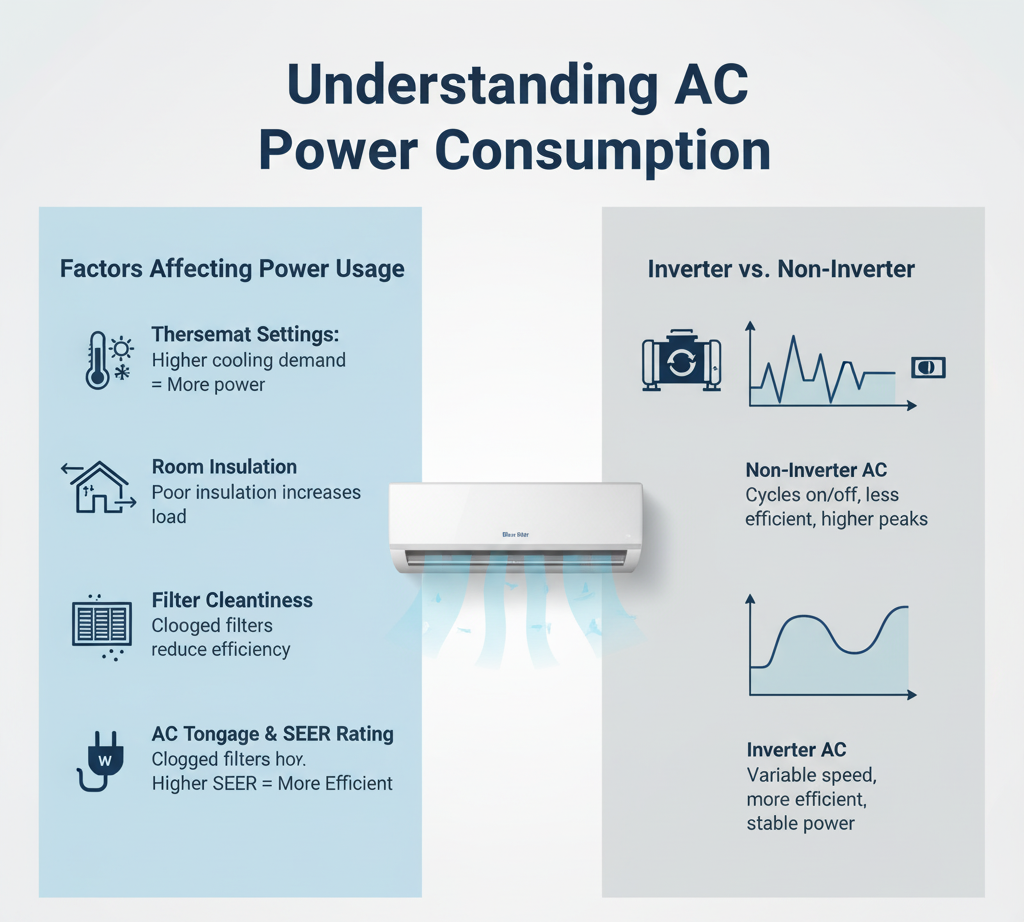
What Affects an AC’s Power Usage
Not all Blue Star ACs use the same amount of power. There are several reasons why your unit would require a certain amount of energy in order to cool down your room efficiently.
Here’s a breakdown of the main ones:
1.Tonnage (Cooling Capacity)
Tonnage in an AC defines the amount of heat it is capable of removing from a room within an hour.
- A 1-ton AC is ideal for small rooms of area up to 120 sq. feet.
- A 1.5-ton AC fits medium rooms, about 120–180 sq. ft.
- This 2-ton AC is suitable for large-sized spaces above 180 sq. feet.
This means that if you had an undersized AC, it would have to work harder and longer in a big room, and will use more power. An oversized AC, on the other hand, might turn on and off frequently, wasting energy through short cooling cycles.to know more check out our Blue Star AC Tonnage Article
2.Star Rating (Energy Efficiency)
The Bureau of Energy Efficiency rates the ACs from 1 Star to 5 Star.
- A 5-Star Blue Star AC efficiently cools the room while it uses less electricity.
- A 3-Star model, while cheaper in the beginning, can be 20–30% more expensive to operate every month.
Think of star ratings as your AC’s “fitness level”: the more stars, the better it handles cooling without burning too much power. If you’re planning to upgrade, this comparison of 5 Star vs 3 Star Blue Star ACs will help you choose the most power-efficient option.
3.Usage Pattern and Temperature Setting
Operating your AC for longer hours or at low temperatures, like 18°C, keeps the compressor running all the time, which draws more power.
Experts suggest setting the thermostat between 24°C and 26°C because it keeps you comfortable while reducing the power consumption by up to 20%.
4.Room Size, Layout, and Insulation
A well-insulated but small room is cooled faster, maintaining the cooled temperature longer.
If your room is poorly insulated, has gaps around the door or window frames, or lets in direct sunlight through big glass panes, cool air escapes easily, thus making your AC run longer and harder.
It can make quite a difference in energy savings by simply adding curtains, blinders, or weather strips.
5. Temperature and Climate
Outdoors During hot weather, your AC’s compressor has to run more frequently to maintain the interior temperature set in the thermostat. In cities experiencing extreme heat or humidity, like Chennai or Delhi, power usage may increase by 10–15% over the consumption in moderate climate cities.
How Much Power Does a Blue Star AC Consume?
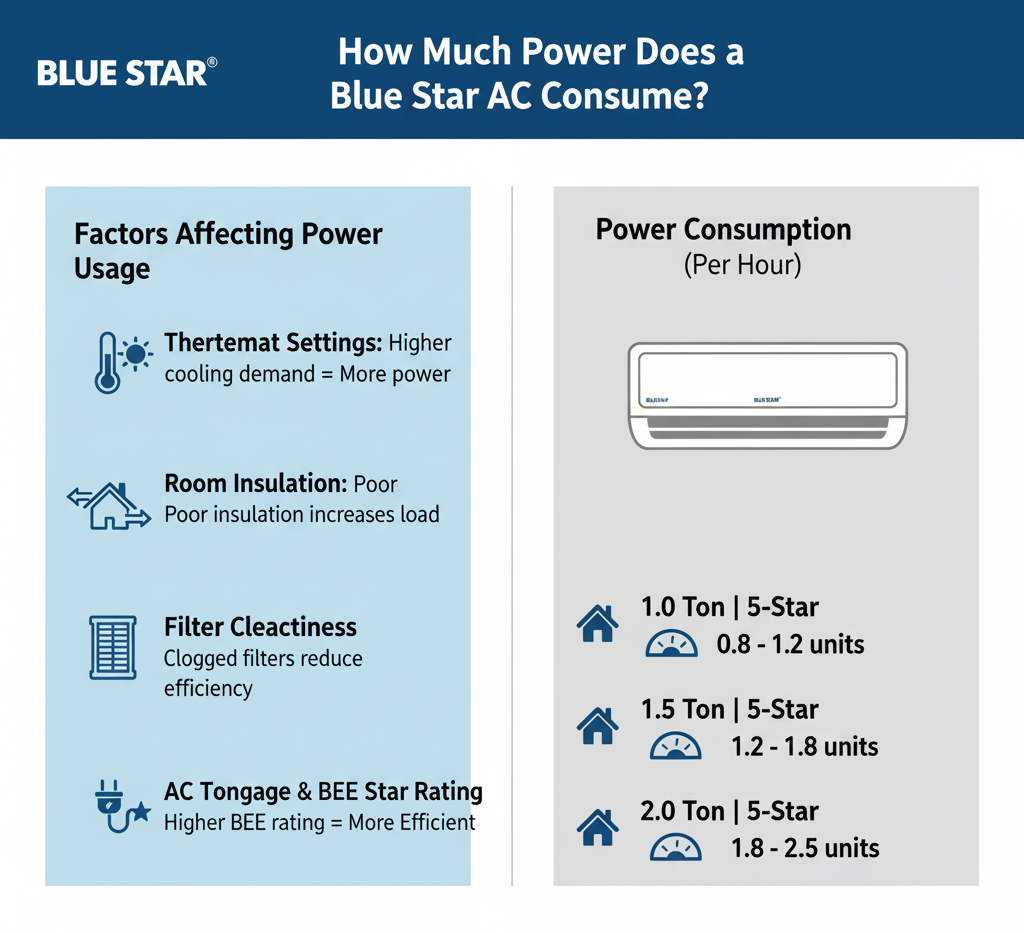
Not all of them consume the same amount of electricity, and not all air conditioners are alike. Blue Star has an entire range of Split and Window ACs available for rooms of varying sizes, with varying levels of efficiency. Understanding how much power each type consumes will help in picking the right model that suits your needs and your electricity bill.
Split vs. Window AC Power Consumption
| Type | Average Power Usage (1.5 Ton) | Efficiency |
|---|---|---|
| Split AC (Inverter) | 1.2 – 1.6 kW/hour | High |
| Window AC | 1.5 – 1.8 kW/hour | Moderate |
Split inverter models by Blue Star are more energy-efficient as they adjust compressor speed based on cooling needs, while Window ACs consume more due to single-speed compressors.
Clear winners, as far as energy efficiency is concerned, are Split Inverter ACs from Blue Star. Why? Because they come with an inverter compressor that automatically adjusts its speed according to the room temperature. Once the room cools down, the compressor will decelerate too and consumes lesser electricity while keeping you comfortable.
On the other hand, window ACs have only a single-speed compressor, which, after periods of operation, switches on/off periodically in order to cool the air. So, every time the unit restarts, there is an inrush current drawn by it, which translates to more power consumed each time the unit is used.
Other advantageous features of the Split models by Blue Star include copper condenser coils and advanced filtration systems. These not only help in increasing the cooling performance but also in keeping the AC running effectively for years without wasting much energy.
1 Ton, 1.5 Ton, and 2 Ton Models Explained
It means cooling capacity and has absolutely nothing to do with weight in the case of AC. It measures how much heat an AC can remove in an hour. Power consumption goes up with increased tonnage:
- 1 Ton Blue Star AC can be utilized in small-sized rooms, as it covers up to 120 sq. ft. The average consumption would therefore be around 0.9 to 1.1 units per hour, considering the star rating and type of compressor.
- Blue Star AC 1.5 Ton: These are ideal for medium-sized rooms from 120–180 sq. ft. In this category, the power consumption ranges from 1.2 to 1.6 units per hour.
- 2 Ton Blue Star AC: This is right for large-sized living spaces or halls above 180 sq. ft. It consumes about 1.8 to 2.2 units per hour.
Remember, the bigger your room and the hotter the environment, the more energy will be required by the AC to cool it comfortably.
Star Ratings and Their Impact: Star ratings are like an energy efficiency scorecard of your AC. That means with more stars, your Blue Star AC will consume lesser electricity for the same amount of cooling. Compared to the 3-Star model, a 5-Star Blue Star Inverter AC saves about 25–30% of electricity. That would translate to saving ₹6,000-₹10,000 over one year, depending on use. A 3-Star model might appear cheaper upfront, but if one is living in a hot city and the AC runs for many months, a 5-Star AC will pay for itself soon enough in lower power bills. In short: Split inverter + 5-Star = Maximum energy savings. Window + 3-Star: cheaper upfront, more expensive over the longer run.
Real-World Example: Electricity Bill Calculation
Example for a 1.5 Ton 5-Star Inverter Model
- Power Input: 1.3 kW
- Usage: 8 hours/day for 30 days
- Energy Consumed: 1.3 × 8 × 30 = 312 units/month
- Cost (₹8/unit): ₹2,496 per month
Example for a 1.5 Ton 3-Star Non-Inverter Model
- Power Input: 1.7 kW
- Usage: 8 hours/day for 30 days
- Energy Consumed: 1.7 × 8 × 30 = 408 units/month
- Cost (₹8/unit): ₹3,264 per month
That’s a saving of nearly ₹768 every month — over ₹9,000 a year — just by choosing a 5-star inverter AC!
Key Features That Help Blue Star ACs Save Electricity
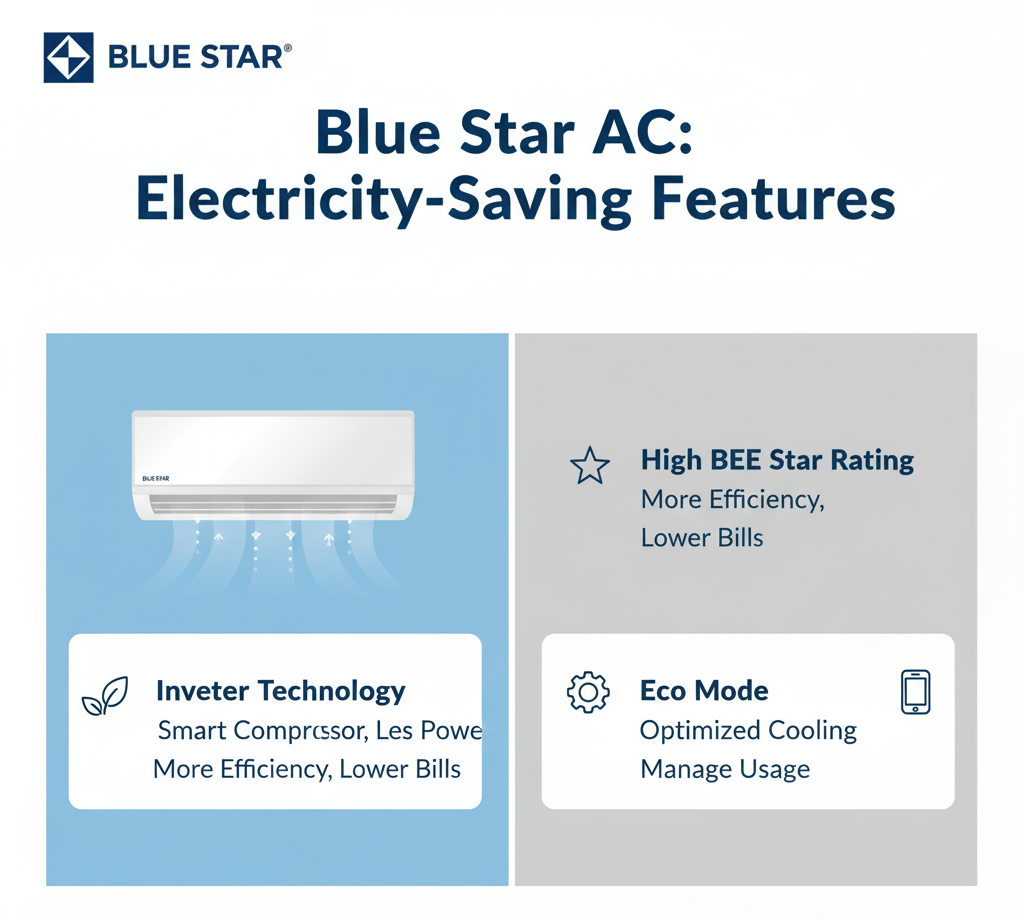
It’s not about ‘cooling’, it’s about ‘smart cooling’ with Blue Star. There is a host of innovative technologies that the brand has packed into its ACs for powerful performance and minimal electricity consumption. Let’s take a close look at these features that make Blue Star ACs the energy-efficient champions.
Inverter Compressor Technology
Every energy-efficient Blue Star AC has an inverter compressor at its core. Non-inverter ACs work on a plain on/off operation-once the room attains the set temperature, the compressor switches off; if it heats up further, it restarts. This leads to power spikes and uneven cooling.
It is different in the case of the inverter compressor used by Blue Star, which automatically adjusts its speed depending upon the cooling demand of your room. When your room reaches the set temperature, for example, it just does not switch off; it only decelerates to maintain constant comfort with a minimum amount of energy being consumed.
The result?
- Smooth and stable cooling
- Lower power bills
- Longer compressor life
You can relate it like driving a car: when you drive at the same speed over the highway, you are more fuel-efficient than by constant braking and accelerating. The same is the case with inverter technology as it works under the same pattern. Consistent operation wastes less energy.
Eco Mode & Sleep Mode
Two small buttons make a big difference.
Eco Mode: During periods of low demand for cooling, such as in the late evening or overcast conditions, this mode decreases the workload on the compressor. In addition, it operates to optimize comfort with less power consumption.
Sleep Mode: Suitable for night times, it automatically adjusts the temperature while you sleep. It will gradually increase the temperature in steps of 1 or 2 degrees Centigrade through the night to avoid overcooling and also helps save power on the compressor. Learn how to activate and use these modes correctly in our complete Blue Star AC remote control usage guide.
A combination of these smart modes can, therefore, help save up to 10–15% of electricity every day, especially for longer hours of usage.
Blue Star’s Smart Sensors and Filters
With intelligent sensors and air filtration technology, Blue Star takes energy efficiency beyond the compressor.
- iFeel Sensors: The sensors in the remote will detect the temperature right where you are in the room, not just near the AC. Precise cooling to your comfort zone, without overcooling and energy waste, is thus achieved.
- Dust & PM 2.5 Filters: Clean filters assure better air flow; this allows the AC to cool faster with less effort, while build-up of dust compels the unit to work harder, consuming more electricity.
In other words, the cleaner the air, the smoother the performance, which means lower consumption of power and a healthy environment in your home.
Practical Electricity Saving Tips for Blue Star AC Users
Even the most energy-efficient AC cannot save electricity if it’s used carelessly. The good news? With just a few smart habits, one can enjoy cool comfort and still manage to keep their electricity bills in order. Here are some simple but powerful ways in which you can make your Blue Star AC work efficiently and economically.
1.Choose the Right Capacity
The correct AC capacity for your room size is the first step towards energy savings. An oversized AC cools the room too quickly, leading to frequent on-and-off cycles that waste power. An undersized one will keep running all the time to try and reach the desired temperature, once again consuming more electricity.
Here’s a quick guide:
- Up to 120 sq. ft. Go for a 1 Ton Blue Star AC.
- 120–180 sq. ft – Choose one with 1.5 Ton capacity.
- Above 180 sq. ft – Choose a 2 Ton AC
Also consider factors like ceiling height, sunlight exposure, and number of occupants. A slightly larger AC might be better for top-floor or west-facing rooms that get more heat.
2.Keep the Temperature Setting Properly
Each degree you raise your AC temperature makes a big difference in energy consumption. Running the AC at 18°C might feel refreshing, but it forces the compressor to work overtime.
Try setting your thermostat between 24°C and 26°C to strike that sweet spot of comfort and energy-savings. Energy experts say that adjustment alone can reduce electricity consumption by as much as 20%.
Tip: If you have a Blue Star inverter AC, then Eco Mode pairs well with it to offer optimum efficiency at moderate weather conditions.
3.Ensure Regular Maintenance
Like every other machine, your AC needs maintenance as well. Clogged filters and dusty coils, or blocked vents, make the unit work harder, increasing its power consumption.
- Clean air filters every 10–15 days if heavily used.
- Servicing by professionals should be scheduled twice a year: before and after summer.
- The outdoor unit must be kept free of leaves, dust, and other obstacles.
A properly cared-for AC will cool more quickly and last longer, translating into energy savings and lower repair bills. If your AC shows performance issues despite maintenance, this Blue Star AC error codes guide can help you diagnose the problem easily.
4.Seal Windows and Doors Properly
The cool air leaks are silent bill killers. When cold air escapes through gaps, cracks, or an unsealed window, it constantly forces your AC to work harder so that the set temperature is maintained.
Seal the air leaks with rubber weather strips, foam seals, or a door sweep. This simple DIY solution may save you up to 10–15% in cooling.
5.Use Curtains or Blinds
Direct sun warms up a room fast-and your AC has to compensate by running longer. Thick curtains or blackout blinds can help shut out the sun’s rays and reduce indoor heat gain.
If possible, use light-colored curtains. These curtains reflect sunlight rather than absorbing it. Keep your blinds closed during the day and then open them in the evening for natural ventilation.
6.Turn Off When Not in Use
Keeping the AC running when you are not there is like leaving a tap running — pure waste. Always turn it off when not in use.
More convenience can be added with the help of timers or smart plugs that automatically switch on/off at certain times. Most of the latest Blue Star inverter models have Wi-Fi connectivity to let you operate your AC from a distance using mobile apps, hence preventing unnecessary usage. Bonus Tip: Combine these habits of proper temperature, timely maintenance, and smart controls; you could save up to ₹1,500–₹2,000 a month on your electricity bill, especially during peak summer.
Seasonal and Regional Considerations

For Coastal Areas
The dry mode in your air conditioner works best in humid cities like Chennai or Mumbai. It removes excess moisture from the air and keeps you cool without overworking the compressor, thus saving noticeable energy.
To enhance performance,
- Close the doors and windows to block humid air from entering.
- Run a ceiling fan on low for better circulation.
- Clean them regularly: salt and moisture may block filters, reducing efficiency.
This will keep it running with efficiency over the years. Regular servicing also helps prevent corrosion, that common coastal problem.
For Hot and Dry Climates
Keeping the temperature of AC at 24-26°C in Delhi and Jaipur-like cities will give you all the cooling with efficient saving of electricity. Setting it too low will just waste electricity without cooling any faster.
Quick efficiency tips
- During the day, close curtains and blinds to block out sunlight.
- At night, if it is cooler outside, run your fans in the fan mode.
- Keep the outdoor unit shaded but well-ventilated.
A minor adjustment like this will keep your Blue Star AC efficient and comfortable throughout the year.
Comparing Power Efficiency: Blue Star ac vs. Other ac Brands
Energy Efficiency Ratio (EER)
The range of EER in Blue Star ACs is between 3.7 and 5.0, which is the best and even the most excellent score compared to other brands available in the market, like Voltas, LG, and Daikin. A higher EER would mean more cooling for less power, which is where Blue Star stands out.
For instance, a Blue Star 5-Star Inverter AC (EER 4.8–5.0) consumes considerably less electricity when compared with other companies’ 3-Star models, which provide an EER of 3.3 to 3.5. In other words, Blue Star ACs ensure effective cooling at lower bills, especially when in use for long hours each day.
Upgrading to an inverter compressor can reduce electricity bills. Check the Blue Star inverter AC compressor price and benefits before upgrading.
Inverter Technology Comparison
The apparent reason behind this superior capability of Blue Star is its twin rotary inverter compressors. Whereas most systems operate on a single inverter, they adjust their speed precisely according to room temperature for smooth, silent, and efficient cooling.
Key benefits:
- Energy savings up to 25–30%
- Smoother cooling without continuous cycling of the compressor.
- Longer lifespan because the strain is less.
There are several brands still manufacturing single inverters, but twin rotary technology and smart sensors make Blue Star one of the most power-efficient options in India today.
Common Myths About AC Power Consumption
Myth 1: Turning Off Frequently Saves Power
Wrong! Each restart makes the compressor draw more current. It’s better to keep the AC running steadily in Eco Mode once the room cools.
Myth 2: 1-Ton AC Always Uses Less Power
Not necessarily. A 1-ton AC running nonstop to cool a large room might consume more than a 1.5-ton AC operating efficiently for shorter cycles.
Myth 3: Higher Star Rating Means the Same Savings for All Users
Savings depend on your usage pattern, region, and maintenance — not just the stars on the sticker.
You can also compare electricity-efficient models in our updated guide to the Best 1.5 Ton Split AC in India, where we’ve included ISEER ratings and real-world power consumption estimates.
Long-run Benefits of Energy Efficiency
Lower Bills, Longer Life
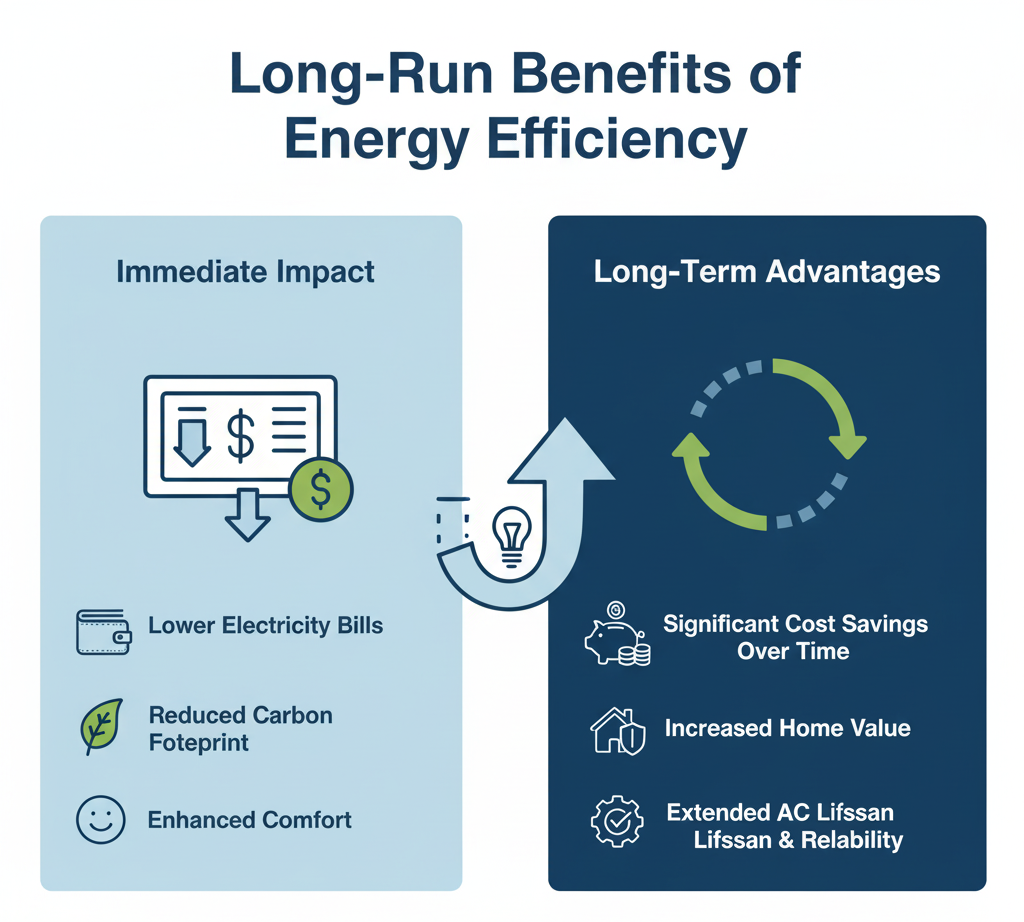
The energy-efficient Blue Star ACs save money and last longer. Their inverter compressors and smart sensors reduce strain by smoothly adjusting power use. Thus, preventing frequent on–off cycles, which consequently means fewer breakdowns, maintenance costs, and a longer life expectancy-usually 2–3 years more than the non-inverter ones.
That translates directly into smoother performance, meaning consistent cooling and steady savings year after year.
Green Cooling
Using less power helps the planet even more. Blue Star ACs come with eco-friendly refrigerants like R32 and R410A, featuring low global warming potential without any ozone depletion. Consuming less electricity and using greener gases means that Blue Star ACs cut carbon emissions while keeping your home comfortably cool.
You save money and help keep the environment a little cooler, too.
FAQs
1.How to find the exact power consumption of my Blue Star AC?
Check for the Energy Label on your AC or refer to the user manual, which mentions power input in watts along with star rating details.
2.Does inverter technology save that much power?
Yes, inverter compressor models save up to 30–40% of consumption compared to non-inverter ones, especially if one uses them regularly.
3.Does running AC at 18°C make it bad for power bills?
Of course, running it at 18°C overworks the compressor. Always run at 24-26°C for efficiency and comfort.
4. Which is the most energy-efficient Blue Star AC model in 2025?
Blue Star 5-Star Inverter Split AC with a Copper Condenser is one of the best, most powerful coolers that consume less energy.
5.Can wrong AC settings increase power consumption?
Yes. Incorrect temperature settings and modes can increase electricity usage. Refer to this Blue Star AC remote control functions article to use Eco, Sleep, and Dry modes correctly.