If you own a Blue Star AC, you’ve probably seen words like PM2.5, anti-bacterial, or activated carbon filter on the box. Sounds fancy, right? But what do these filters actually do—and are you taking care of them the right way?
Here it is:
Even the most powerful AC is only as good as its filter. A clean filter means cooler air, cleaner air, and lower electricity bills. A dirty one? Think weak cooling, bad smell, dust everywhere, and rising power consumption. That’s why, in this guide, we are breaking down Blue Star AC Filters in the most straightforward manner possible: types, their benefits, steps for cleaning, and smart maintenance tips that will keep your AC running like new.
Why AC Filters Matter More Than You Think
The general belief is perhaps that the job of an AC is quite straightforward-switch on, feel cool, and enjoy. But inside every Blue Star AC, there’s an unsung hero at work: the air filter. This small, mesh-like component plays a huge role in how your AC will perform, in how much electricity it consumes, and even the quality of air you breathe every day.
Think of your AC filter as a first line of defence against all that’s floating in the air, from dust and smoke down to pet hair, pollen, bacteria, and even microscopic pollutants you can’t see. If it weren’t for that filter, that junk would circulate freely in your room, settling on your furniture, floor, and even your lungs.
A clean, healthy AC filter works wonders:
- The filter will improve indoor air quality: by trapping pollutants before they can enter your room, thus ensuring a fresher and cleaner atmosphere for you to breathe, especially if you happen to live in a dusty area or near a main road.
- Lower electricity bills: Clean filters allow air to pass through the AC smoothly. This lessens the load applied by the compressor and assists in cooling the air faster using the AC, reducing power consumption up to 10–20%.
- Prevent AC breakdowns: A dust build-up is the main reason for overheating in air conditioners and further causes complications in coils. A clean filter protects the internal parts and reduces the possibility of sudden repairs.
- Improve cooling performance: Ever feel that your AC just isn’t cooling as much as it’s used to? About 90% of the time, this is due to the filter. A clean filter can make the flow of cool air a lot stronger and much more consistent.
It would just be like trying to breathe through a thick cloth mask; the airflow is weak, laboured, and even uncomfortable. That is how your AC struggles when its filter is clogged up. This means it has to work much harder, consume more power, and cool down more slowly.
Yes, AC filters do matter much more than you think they do. Keep them clean, and your AC will reward you with smoother cooling, better performance, and healthier air.
Types of Filters Used in Blue Star ACs
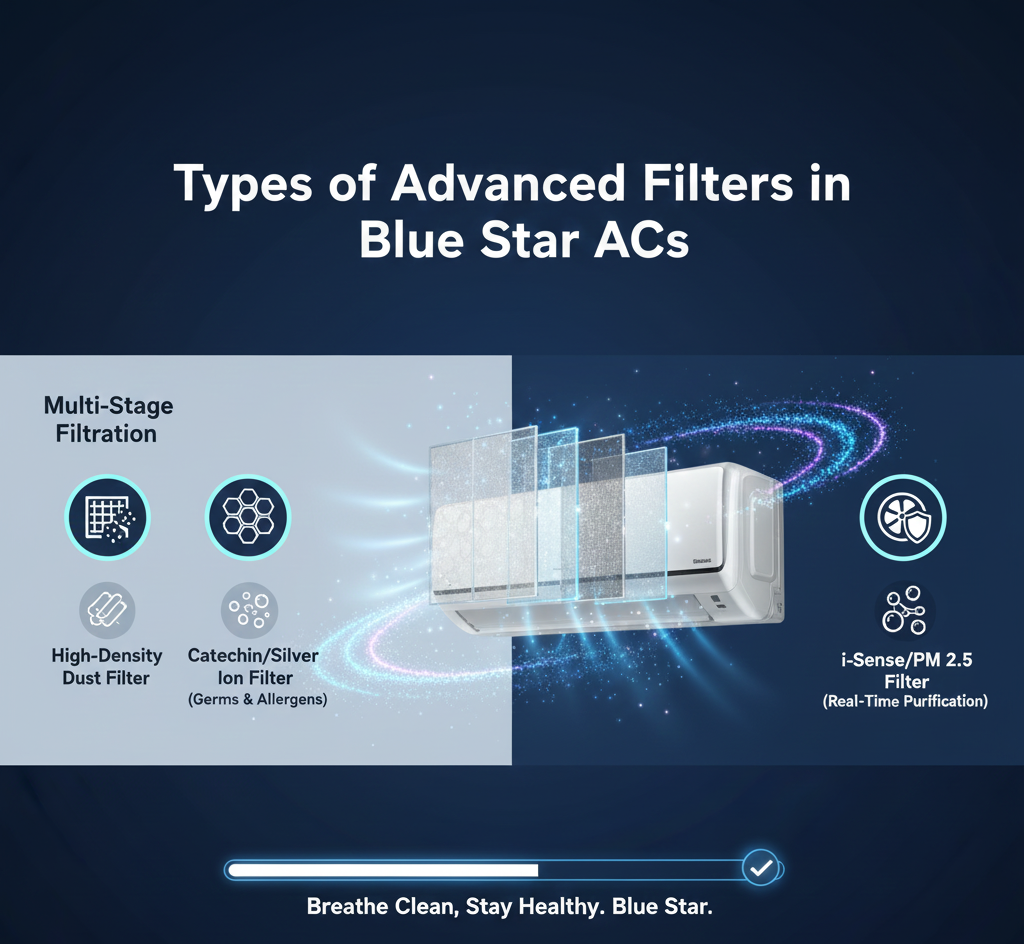
Blue Star ACs are known not only for their cooling but also for multi-layered, advanced filtration mechanisms. Depending on the model you have, one or a number of the following filters may be included with your AC: each has a different kind of role to fulfil, working collectively to make the air inside your house cleaner, fresher, and healthier.
We will explain each filter in detail.
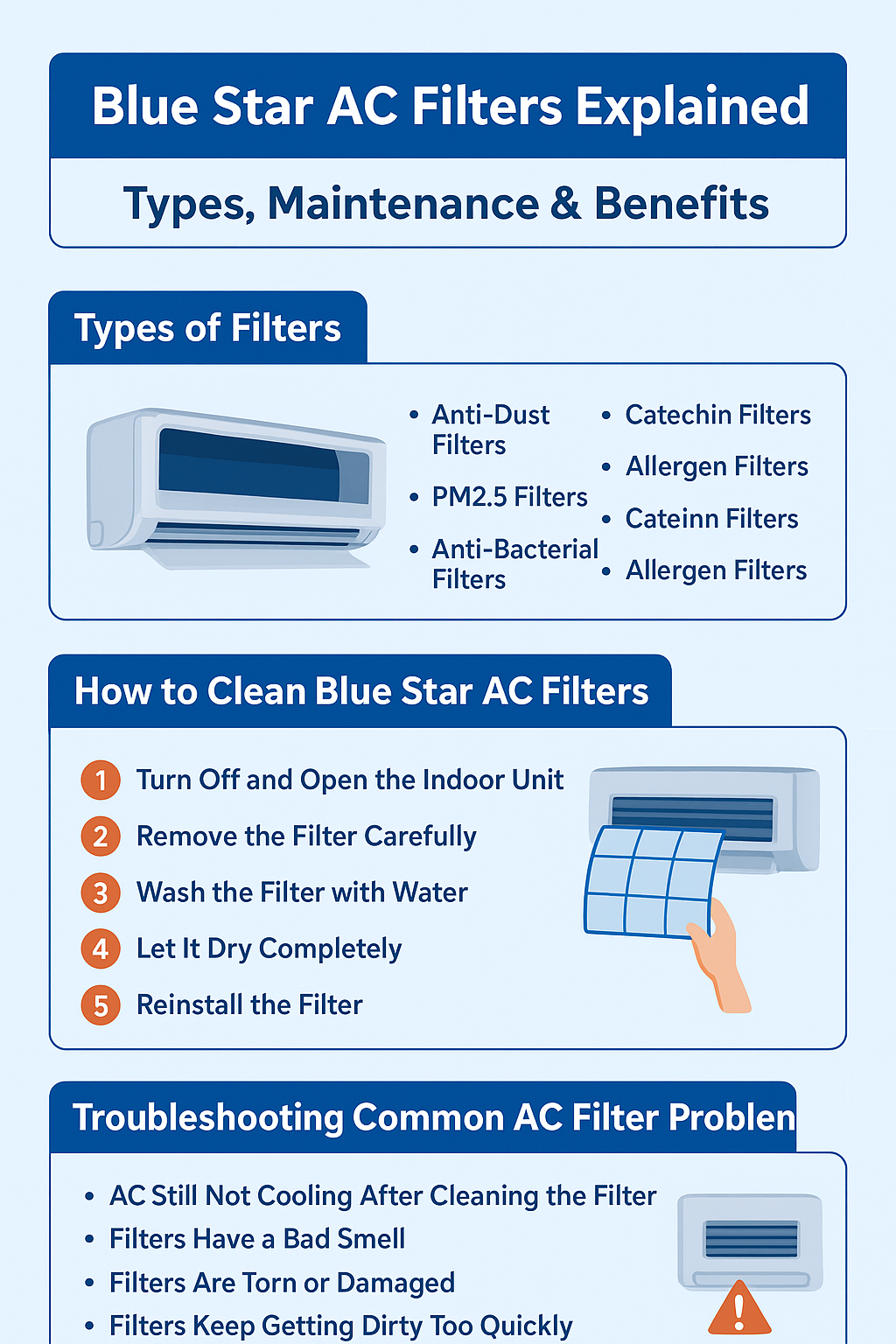
1.Anti-Dust Filters
Anti-dust filters are the basic yet most crucial filters used in almost every Blue Star air conditioner. They work just like the first protective barrier inside your AC.
How Anti-Dust Filters Work
These filters capture:
- Large dust particles
- Hair strands
- Pet fur
- Pollen and floating fibbers
These are larger airborne impurities that we can often see settling around our homes. Once these particles are blocked, the airflow inside your AC will be smooth and without hindrance. This also avoids dust coating the evaporator coils, which is a major cause of weak cooling and higher consumption of electricity.
Anti-dust filters alone can improve the efficiency of cooling by 10–15%, if kept clean.
2.PM2.5 Filters
The PM2.5 filters target modern Indian homes, especially in metro cities that are highly polluted.
PM2.5 particles are ultra-fine pollutants that:
- 30 times smaller than a human hair
- Invisible to the naked eye
- Highly injurious by inhalation
Why PM2.5 Filtration is Important
Health effects from exposure to PM2.5 include:
- Difficulty breathing
- Sneezing/throat irritation
- Irritation of the eyes
- Asthma attacks
- Long-term respiratory issues
This PM2.5 filter from Blue Star removes these microscopic pollutants from the circulating air, making it much safer to breathe for children and elders, and especially for people who are prone to allergies or asthma.
3.Anti-bacterial filters
Anti-bacterial filters are treated with special anti-microbial agents that neutralize bacteria and germs caught in the filter surface.
These filters are particularly useful for:
- Homes with infants or kids
- People who are allergic
- Clinic or hospital rooms
- People with low immunity
They reduce the spread of everyday respiratory infections by cleansing the air reaching your lungs.
4.Activated Carbon Filters
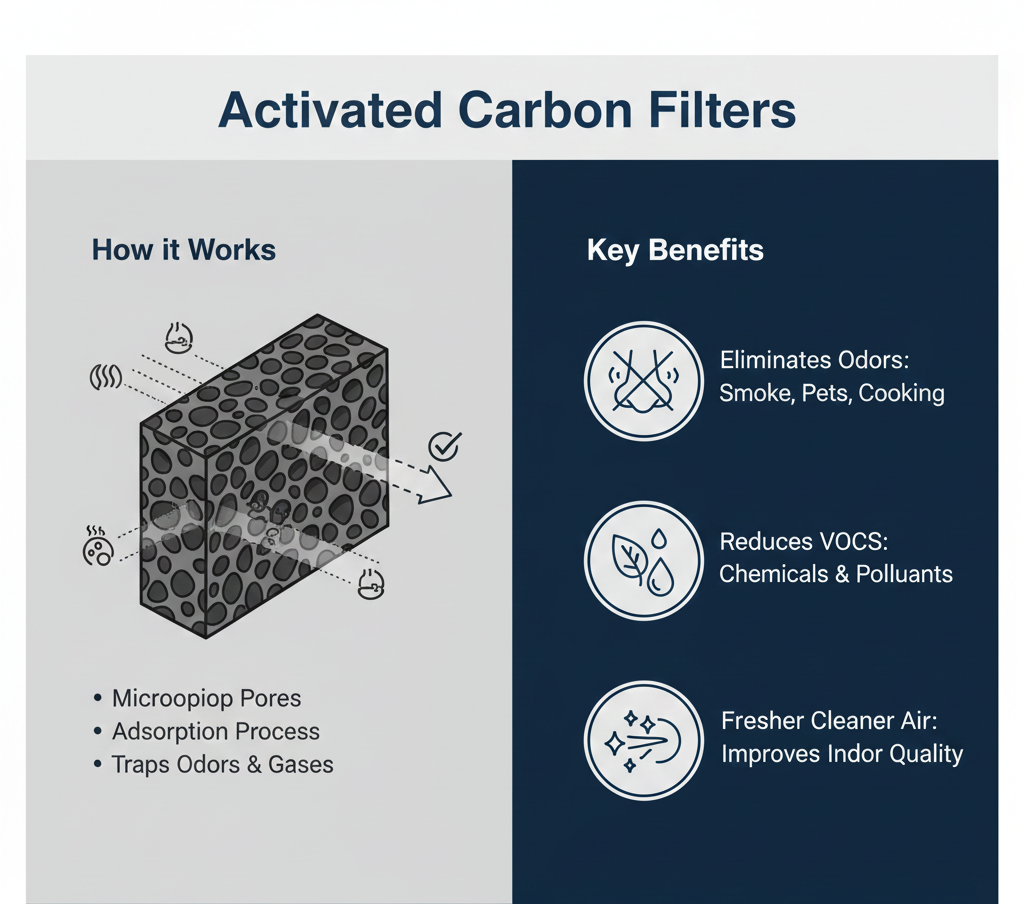
Activated carbon is noted for its superior absorption qualities.
These filters effectively remove:
- Bad odours from pets or cooking
- Smoke and fumes
- Chemical vapours
- Volatile organic compounds (VOCs)
Activated carbon filters make quite a difference if one is living near a highway, industrial zone, or petrol bunk-or in a kitchen-heavy environment. They keep indoor air fresh and neutral due to the possibility of absorbing unwanted smells and gases.
5.Silver Ion Filters
Silver ions are among the most powerful natural disinfectants. They disrupt cell structure and destroy harmful microorganisms.
Silver ion filters can help in eliminating
- Bacteria
- Mould spores
- Certain viruses
This filter cleans the air and, at the same time, prevents bacterial growth inside the AC unit. That means less foul smell, improved hygiene, and healthier airflow each time you turn on the AC.
6.Catechin Filters
It is a natural compound extracted from the leaves of green tea. It is used as an anti-oxidant and for antibacterial purposes.
Catechin filters help combat:
- Airborne viruses
- Harmful germs
- Unpleasant odors
They help avoid the spread or circulation of harmful microorganisms in a room and reduce sweaty or stale smells in closed spaces.
7.Allergen Filters
This is one of the most critical filters for those staying at home who suffer from dust allergies, sneezing, or sinus problems.
Allergen filters capture:
- Dust mites
- Fine allergens
- pollen particles
This type of filter keeps the air in your room free from common allergy triggers and is extremely useful for people who suffer from respiratory sensitivity.
Modern Blue Star ACs come with advanced filtration systems along with smart features. If you want to explore all important features before buying, check out our guide on Top Features to Look for in a Blue Star AC.
Comparison Table for Blue Star AC Filters
| Filter Type | Main Function | Removes / Protects From | Best For | Washable? | Found In |
|---|---|---|---|---|---|
| Anti-Dust Filter | Blocks large dust and debris | Dust, hair, pet fur, pollen | All households | ✔ Yes | Almost all models |
| PM2.5 Filter | Captures ultra-fine pollutants | PM2.5 particles, pollution, smoke | Urban homes, polluted cities | ✘ No | Newer inverter models |
| Anti-Bacterial Filter | Neutralizes germs and bacteria | Bacteria, microbes | Homes with kids/seniors, clinics | ✔ Sometimes (depends on coating) | Mid & high-end models |
| Activated Carbon Filter | Absorbs smells & chemical fumes | Odours, smoke, VOCs, kitchen smells | Homes near roads/industries/kitchens | ✘ No | High-end models |
| Silver Ion Filter | Destroys harmful microorganisms | Bacteria, mould, certain viruses | Humid areas, allergy-prone users | ✘ No | Premium models |
| Catechin Filter | Fights germs naturally | Airborne viruses, foul smells | Bedrooms, closed spaces | ✔ No (needs replacement) | Mid to high-end models |
| Allergen Filter | Reduces allergy triggers | Dust mites, allergens, pollen | Allergy sufferers, asthma patients | ✘ No | Top-tier models |
Which Blue Star models come with these filters?
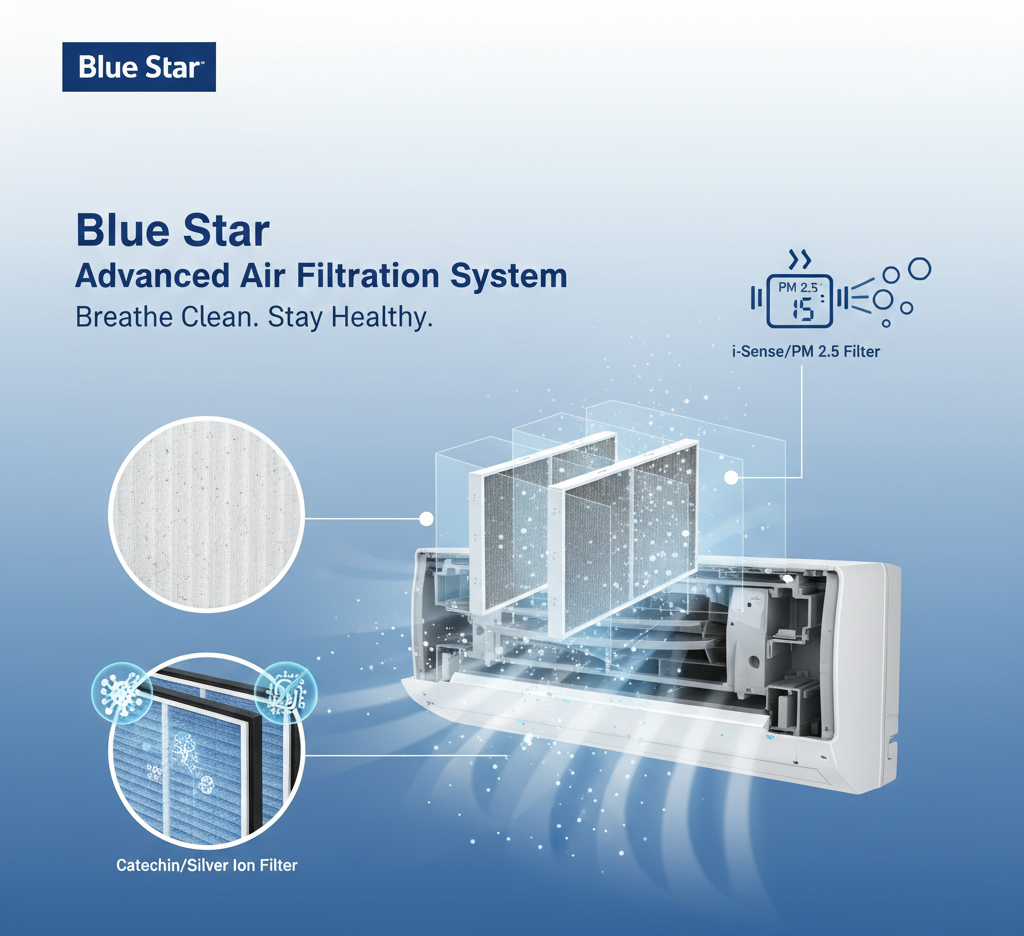
Different series of ACs offered by Blue Star require different filtration technologies. The exact combination, however, would depend on the series and price range along with the cooling capacity. While features may vary, here is a more coherent picture of what you can generally expect:
Anti-Dust Filters → present in almost all the models
Pre-installed anti-dust filters range from entry-level non-inverter ACs to high-end inverter ACs. They provide a basic protective layer that keeps your sensitive internal parts safe while guaranteeing smooth airflow.
PM2.5 Filters → Common in Newer Inverter Models
Most of the Blue Star inverter ACs launched over the last 2–3 years come with PM2.5 filtration. These are designed keeping urban pollution in mind, particularly in cities like Delhi, Mumbai, Bengaluru, and Chennai.
Activated Carbon & Anti-Bacterial Filters → Mid & High-End Models
In the case of a mid-range or premium category inverter AC, you will very often find both an activated carbon and anti-bacterial filter. The models emphasize comfort and hygiene; they would be ideal for homes near main roads, kitchens, or other places full of dust.
Silver Ion & Catechin Filters → Premium Models
The top-of-the-line models, especially the “Health+” or advanced inverter series, come with either silver ion or catechin filters. These filters have deeper air purification, targeting germs and viruses and unwanted doors.
Allergen filters → mainly in flagship models
The allergen filters are usually reserved for the highest-end models in a series designed for families that have sensitive lungs, asthma, or dust allergies.
Always check the official specification of the model or check out the product manual to make sure which filters are included within your particular AC.
Benefits of Blue Star AC Filters
More than just cooling your room, the Blue Star ACs clean your air, protect your family’s health, and keep your AC at peak performance through silent operation. These ACs have a number of benefits that most people hardly recognize if installed with the right filters and cleaned regularly.
1. Cleaner, Fresher Indoor Air—Every Single Day
No matter how much you sweep or shut the windows, dust and pollution always manage to get into your house in India. That is where Blue Star’s sophisticated filters come in.
Each layer forms a shield: Anti-Dust, PM2.5, Anti-Bacterial, and Activated Carbon block particles like
- Household dust
- City smoke
- Pollen and allergens
- PM2.5 pollutants
The germs and bacteria:
- Unpleasant odours
The result?
Your AC serves as an air purifier, giving you healthy and fresh air, not just cold air.
2. Noticeably Better Cooling & Faster Temperature Drop
- Ever felt that the AC isn’t cooling like before?
- The real culprit is more often than not a dirty filter.
- When filters get clogged up, your AC struggles to breathe. Airflow drops. Cooling slows down. And your electricity bill starts to go up.
- Yet, it is possible to improve the efficiency of cooling by 15–20% with clean filters.
That means:
- Faster cooling
- Reduced monthly bills
- Smooth, quiet operation
Your AC doesn’t have to “fight” to cool the room; it works just the way it should. If your AC still struggles with cooling even after cleaning filters, it might be time to upgrade. Here are the best Blue Star ACs under ₹40000 that offer faster cooling and better airflow performance.
3.Longer AC Lifespan & Fewer Repair Costs
A filter is one type of safety net for the internal parts of your AC.
When dust stays out, your AC stays healthy.
Clean filters protect the:
- Evaporator coil
- Compressor
- Fan motor
- from unnecessary load and overheating.
This directly leads to:
- Fewer breakdowns
- Lesser maintenance cost
- An AC that lasts longer and works like new for years
An AC with clean filters just lives longer, period.
4. Healthier Environment for Kids, Seniors & Allergy-Sensitive People
For families with small children, elderly members, or anyone with dust allergies, clean air is not an option-it is a necessity.
Blue Star’s multi-layered filters can remove:
- Allergenic dust mites
- Bacteria and viruses
- Harmful micro-pollutants
- Pet hair and dander
This creates a cleaner, safer, more comfortable indoor environment. Your AC becomes a health protector, not just a cooling machine.
Blue Star vs Other Brands: Filtration Comparison (Short & Crisp)
1. Filtration Technology Comparison
| Brand | Key Filtration Tech | Strengths | Limitations |
|---|---|---|---|
| Blue Star | Anti-dust, PM2.5, Activated Carbon, Silver-Ion, Catechin, Allergen Filters | Balanced multi-layer filtration; great for Indian dust, pollution & odours; affordable models available. | Premium filters (silver-ion, catechin) only in higher-end models; some replacements can be pricey. |
| Daikin | Flash Streamer, Titanium Apatite Filter, Silver Filter | Excellent at breaking down allergens, viruses & chemical pollutants; strong germ control. | Doesn’t fully replace HEPA-level PM filtration; advanced filters cost more to maintain. |
| Panasonic | nanoe-G, PM2.5 Filter, Catechin | One of the best for killing bacteria/viruses; great for polluted cities; strong odour control. | nanoe-G is active purification (slightly higher energy use); tech is more expensive. |
| LG | NEO-Plasma, Nano Carbon Filter, Triple Filter System | Great for allergens, bacteria & odour removal; strong plasma purification. | Plasma filters don’t trap ultra-fine PM2.5 as well; replacement filters can be costly. |
Quick Summary
- Best for Odours & Bacteria: LG
- Best Overall Balanced Filtration: Blue Star
- Best for Allergies & Germs: Daikin
- Best for High Pollution + Odours: Panasonic
How to Clean Blue Star AC Filters- A Step-by-Step Guide
The cleaning of Blue Star AC filters ranks among the easiest yet most influential things you can do to increase cooling, reduce electricity bills, and prolong your AC’s life. The whole process takes 10–15 minutes, and you don’t need any kind of tool or technical skill. Just follow these steps:
Step 1: Switch off and open the indoor unit.
First and foremost, before you start touching anything, ensure that the AC is turned off via remote and, if possible, from the main switch. This keeps you safe, and it does prevent dust from being pulled inside the unit.
Now, gently lift the front panel of the indoor unit. Most Blue Star AC panels are designed with soft hinges: just insert your fingers under the edge and lift upward until it stays open.
Step 2: Remove the filter carefully
Inside, it houses the two primary air filters, which are usually anti-dust filters.
Reach in and pull the little tabs on the side, sliding the filters outward.
Important:
- Don’t bend or twist the filter mesh
- Handle it lightly, so that the plastic frame doesn’t crack.
If your model has additional filters such as the PM2.5, carbon, silver-ion, or catechin, these might be attached to the main filter or may be inserted into a slot behind it. Gently take those out too.
Step 3: Washing the Filter Thoroughly
Take the filters to a bathroom or balcony.
Then rinse these under running tap water to remove loose dust.
For deeper cleaning:
- Use mild liquid soap
- Use a soft brush – like a toothbrush
- Scrub with soft circular motions.
Avoid:
- Hot water
- Harsh chemicals
- Hard brushing
- These can damage the mesh or coating.
Step 4: Let the Filter Dry Completely
- Shake the filter once to remove excess water.
- Place it in a shaded area – never in direct sunlight, since heat can warp the frame.
- Allow it to dry for 30–60 minutes.
Step 5: Reinstall the Filter
Replace the filters in their slots, making sure they fit snugly once they are completely dry. Close the front panel and then power the AC on. That is all-your AC now breathes easier, cools faster, and consumes less power.
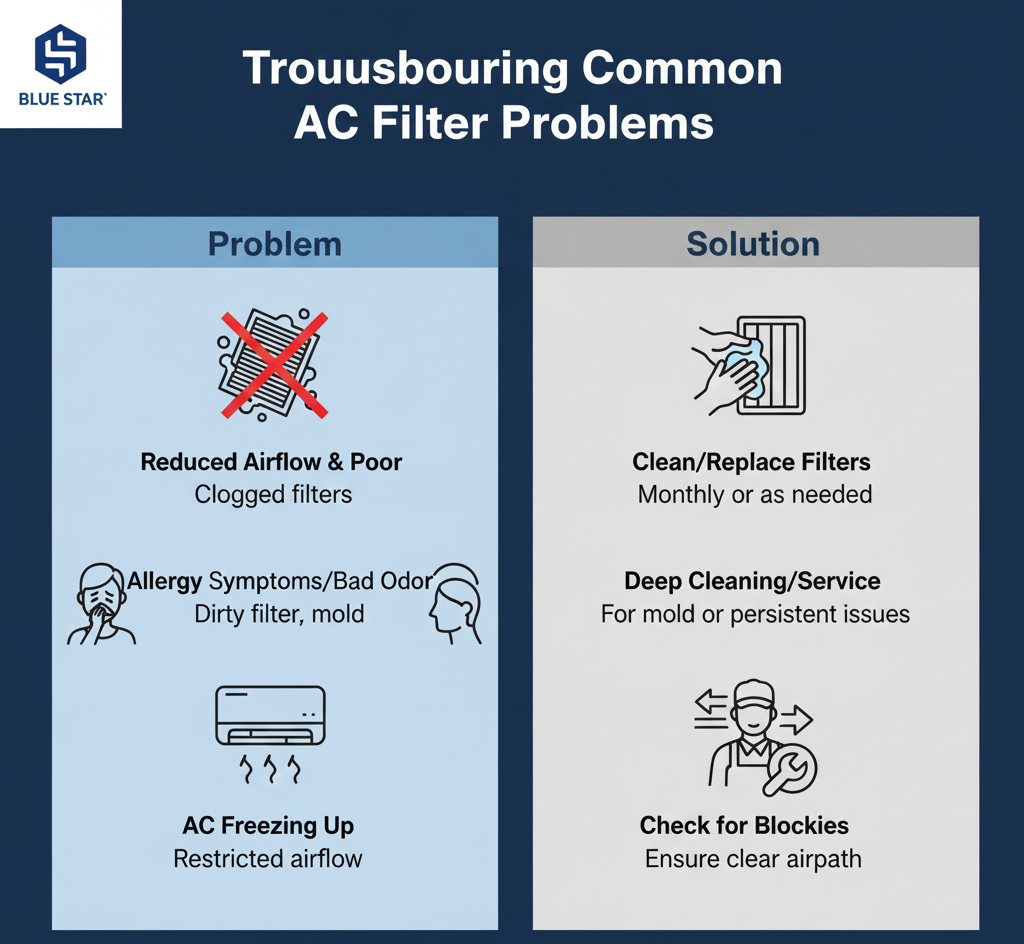
Common Troubleshooting of AC Filters by Blue Star Users
Even with regular cleaning, your Blue Star AC filters may develop some issues from time to time. Don’t panic-most of these have simple fixes. Here’s a quick troubleshooting guide that will help you solve the problems like a pro:
1.AC Still Not Cooling After Cleaning the Filter
If cooling is not enhanced even after washing filters, then check the following:
- Inadequately dried filters: Wet filters block the flow of air.
- Wait 30–60 minutes until they are completely dry, then reinstall.
- Dirty coil behind the filter: The collection of dust on the evaporator coil blocks the flow of cooling.
- You may need a coil cleaning, which can be done by a technician.
- PM2.5/Carbon filter is saturated – these filters cannot be washed and may need replacement.
- Replace them every 6–12 months depending on usage.
2.Filters Give Off a Bad Odour
If you find that a foul smell is coming from the AC:
- Smell of wet filter: It occurs when the filter is not dried appropriately.
- Rewash → Dry completely → Reinstall.
- Mould or fungus smell: Happens if filters stay dirty for too long.
- For deeper cleaning, mild soap and a soft-bristled brush may be used.
- Odours in the room absorbed by carbon filter:
- If it is more than 1 year old, replace the activated carbon filter.
3.Filters are torn or damaged.
Tears in mesh filters affect airflow, reducing dust trapping.
Causes:
- Rough wash
- Using a hard brush
- Direct sunlight exposure
- Old age
Solution:
Change the filter now. The mesh filters aren’t expensive and are easy to install.
4.Filters Keep Getting Dirty Too Quickly
If your filters get dusty every 2–3 weeks:
- Your home could be close to a main road, an industrial area, or even a construction zone.
- You are probably using the AC during months of peak pollution.
- Windows can be left open when the AC is running.
Solutions:
- Clean filters every 15–20 days
- Keep windows shut when AC is turned on
Air curtains or draft stoppers can be utilized to reduce dust entry.
5.Additional filters – PM2.5, Carbon, Silver-Ion do not fit after cleaning.
This occurs when the filters are not in the proper order.
Solution:
- First, insert the main anti-dust filter, then attach the add-on filters.
- Ensure filter placement according to your Blue Star model’s user manual diagrams for gaps or bends.
6. Noise in AC after cleaning the filter Rattling or vibration sounds:
- Filter not correctly locked
- Panel is not fully closed.
Solution: Open again → Reinsert filter → Lock the tabs → Shut panel tight
To know more about Blue Star AC Noise Levels Check out This Article.
7. AC still shows “Filter Clean” reminder even after cleaning.
Most of the latest Blue Star inverter ACs have this feature. If it still appears so, then manually reset the reminder.
How? Press Filter Reset on remote or long press on Options/Settings button as applicable on your AC model.
Frequently Asked Questions
1.How many types of filters does a Blue Star AC have?
Depending on the model, it has between 1 and 5 filters: dust, anti-bacterial, PM2.5, carbon, and allergen filters.
2.Can PM2.5 filters be washed?
No, PM2.5 filters should not be washed but rather changed every 6–12 months.
3.How frequently should I clean my AC filter?
Every 2–3 weeks for better cooling and to consume less electricity.
4.Does a dirty filter increase electricity bills?
Correct. A clogged filter makes the AC work harder, using more power.
5.Is my Blue Star AC able to operate without a filter?
Technically, yes, but highly unsafe. It will damage the coil and decrease cooling apart from voiding the warranty.