If you are living on the top floor in India, trust me for the suffering – your bedroom turns out to be as hot as an oven in summer. The sun strikes the top surface directly, and the temperature is higher compared to other floors by 3-5 °C at least, and a normal AC would find difficulty functioning.
So, what is the solution?
A highly efficient and durable AC that is designed to cope with hot conditions.
In this regard, Blue Star ACs give other air conditioner manufacturers a run for their money. In this article, you would be able to find the best Blue Star AC for top floor rooms.
Why Top Floor Rooms Deserve Better AC

It is important to know all
It receives direct sunlight for 8-10 hours a day. This implies that:
- Higher room temperature
- Heat Load on AC Increase
- Slower cooling
A normal AC may take additional 30-40 minutes to cool compared to lower floors.
Roof Heating and Poor Insulation
Your roofing system is like a “giant frying pan,” soaking up the heat all day and then radiating heat at night.
That is why top floor rooms tend to be hot even after sunset.
Higher Electricity Bills
Due to higher heat, ACs run for longer and use more units.
A high-efficiency Blue Star Inverter AC can minimize this by around 20-30%.
Why Select Blue Star for Top Floor Cooling?
Extraordinary Cooling Capability
Blue Star comes with high ambient cooling: all models cool even at 52°C outside temperature – just what is needed for Indian summers.
Advanced Heat Protection Technology
Typically, the Blue Star AC comes with:
- Anti-corrosive Blue F
- Compressor heavy-duty
- Copper Condenser
These boost performances during hot conditions.
Long Compressor Life
Blue Star compressors are meant for continuous use, and this is what is needed by rooms on the top floor.
Calculation of Heat Load for a Top-Floor Room: (Crucial Information Before Purchasing an AC)
Normally, people select AC tonnage capacity depending on the size of the room. However, for rooms on the top floor, this approach can be very misleading and even life-threatening. Why? It is because the top floor can absorb solar direct heat with a huge capacity.
To select the proper Blue Star AC for the top floor room, one needs to know heat load calculation.
We can unpack this with a more straightforward explanation.
1.Room Size (Length × Width)
It is the foundation for all AC computations.
| Room Size | Normal Floor | Top Floor Recommended |
|---|---|---|
| Up to 110 sq ft | 1 Ton | 1 Ton / 1.2 Ton |
| 120–160 sq ft | 1.2 Ton | 1.5 Ton |
| 170–220 sq ft | 1.5 Ton | 2 Ton |
For top floor rooms, there is a constant requirement for additional capacity ranging from
2.Sunlight Direction (East, West, South Facing)
Sun direction is one factor that contributes to heat generation:
- West-facing rooms → Hottest (afternoon sun)
- South-facing rooms Extremely hot all day
- East-facing rooms → Hot in the morning
- North-facing rooms → Coolest
If your room faces the WEST and SOUTH sides, then you must increase the tonnage even for a small room.
3.Ceiling Height (Highly Important for Upper Floors)
Normal height of ceilings: 9-10 feet
If your ceiling is:
- 11-12 feet Add 10-15% more cooling capacity
- 13+ feet Add 20% Extra Cooling
Why this matters:
Hot air rises and is trapped near the ceilings. Taller ceilings mean more hot air for the AC unit to cool.
4.Roof Construction and Insulation
This is a huge hidden variable that nobody considers.
| Roof Type | Heat Effects |
|---|---|
| Bare concrete roof | Very high heat |
| Tin / metal sheets | Extremely high heat |
| Insulated with tiles | Medium heat |
| Reflective white paint | Lower heat |
If your roofing is concrete or metal, then your AC system has to work much harder – approximately 30-40% more.
5.Number of Windows & Glass Area
Every window brings heat to the room.
- One small window → Normal load
- Two windows → Add 10–15% load
- Large glass windows → Add 20–25% load
For higher floors, with just one large glass window, the AC can be loaded substantially.
6.Number of People & Appliances
Every person releases heat = approximately 600 BTU
Appliance Heat Examples:
- TV → 300-400 BTU
- Desktop PC 500-700 BTU
- near the fridge: 1000+ BTU
When 2-3 people and electronics all run at once, your air conditioning works overtime.
Simple Real Life Heat Load Example (Extremely Important)
Let’s consider this real Indian top-floor bedroom:
- Room size: 12 × 12 ft (144 sq ft)
- West-facing windows
- Bare concrete roof
- Ceiling height: 11 ft
- Two people sleeping
- TV running
Normal calculation (wrong method):
1.2 Ton AC is sufficient
Correct top-floor formula:
Required capacity = 1.7–1.8 Ton
So the correct AC choice is 2 Ton Inverter AC
NOT 1.5 Ton.
This is exactly why so many people tend to complain:
“My AC is not cooling properly on top floor”
Although the AC is perfectly fine – the capacity is wrong.
Quick Top-Floor AC Capacity Formula (EASY RULE)
Use this cheat formula:
Room Size (sq ft) × 1.25 = Required Cooling in Tons
Example:
- 150 sq ft × 1.25 = ~1.9 Ton
Choose 2 Ton AC
This formula adjusts automatically for:
- Roof heat
- Sun exposure
- Poor Insulation
Importance of Heat Load Calculation for Choosing Blue Star AC
Blue Star ACs come equipped with a system to withstand higher temperatures (until 52 °C) – however, even the best AC cannot cope with improper tonnage.
If you choose:
- Correct Tonnage – Quick cooling, Lower energy costs, Longer Compressor life
- Small-Sized AC: Slow rate of cooling; High power consumption; Premature compressor failure
This is the reason why proper heat load computation is the basis for finding the optimal Blue Star AC for upper floor rooms.
Inverter vs Non-Inverter AC for Top-Floor Rooms – Which Is Better?
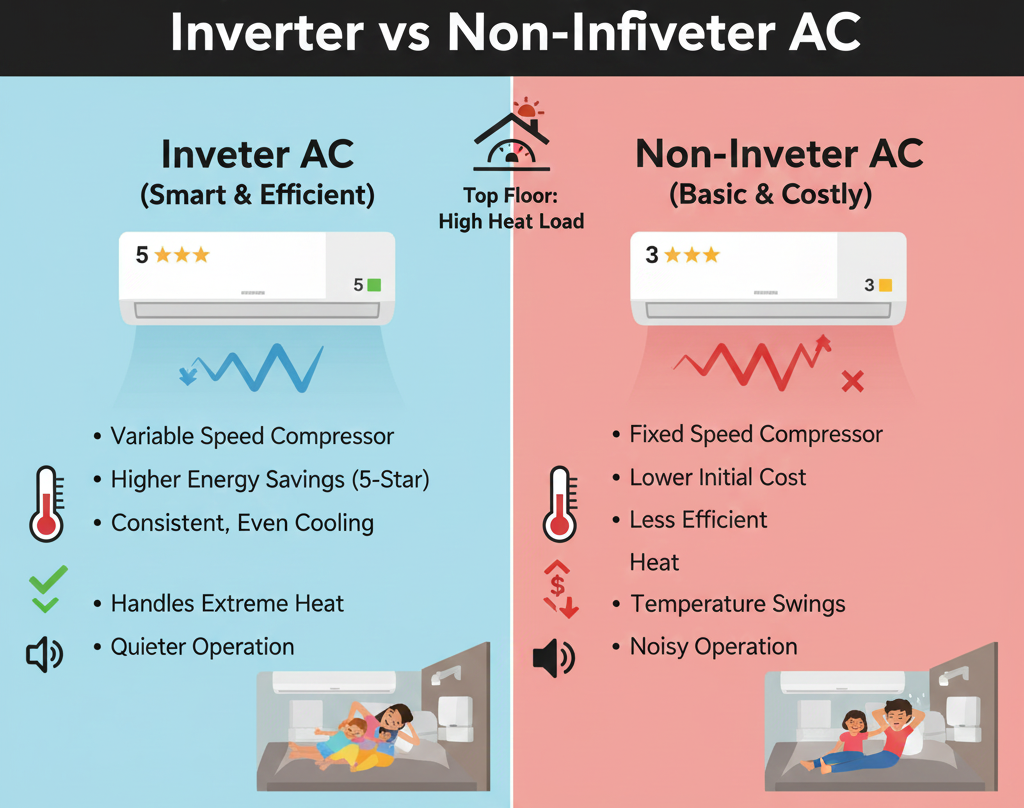
Choosing between an inverter AC and a non-inverter (fixed-speed) AC is one of the most critical decisions for top-floor rooms. Many people make this choice based only on price — and later regret it due to high electricity bills, slow cooling, and compressor damage.
Let’s break this down practically for Indian top-floor conditions.
Performance Comparison for Top-Floor Rooms
| Factor | Inverter AC | Non-Inverter AC |
|---|---|---|
| Cooling Speed | Fast & consistent | Slow after repeated on-off |
| Power Consumption | 30–50% lower | Very high |
| Noise Level | Very silent | Loud |
| Handles Roof Heat | Excellent | Struggles |
| Temperature Stability | Perfect | Fluctuates |
| Compressor Life | Long (10–12 yrs) | Shorter |
| Initial Cost | Higher | Lower |
Winner for Top Floors: Inverter AC (No comparison)
Why Inverter ACs Are Perfect for Top-Floor Rooms
Top-floor rooms face three constant challenges:
- Continuous heat from roof
- Direct sunlight during the day
- High night-time room temperature
An inverter AC:
- Never completely stops
- Maintains stable cooling
- Adjusts power automatically
- Prevents temperature rise during the night
This leads to:
✔ Faster cooling
✔ Better sleep
✔ Lower electricity bills
✔ Less stress on the compressor
Electricity Bill Comparison (Real Indian Example)
Let’s assume:
- Usage: 10 hours daily
- AC capacity: 1.5 Ton
- Location: Hot Indian city
- Season: Peak summer
Inverter AC:
- Daily units: 6–8 units
- Monthly bill (approx): ₹1,800–₹2,400
Non-Inverter AC:
- Daily units: 10–13 units
- Monthly bill (approx): ₹3,000–₹3,900
You save ₹12,000–₹18,000 over 3 years with inverter AC.
Inverter AC Myths – Reality for Top Floors
Myth 1: Inverter ACs don’t cool fast
Truth: Inverter ACs cool faster than non-inverter due to boost mode.
Myth 2: Inverter ACs are costly to repair
Truth: Blue Star inverter compressors come with 10-year warranty.
Myth 3: Inverter ACs are not good in extreme heat
Truth: Blue Star inverter models work till 52°C outdoor temperature.
Best Blue Star AC for Top Floor Rooms in India — 2026 Picks
Below are the top models chosen based on:
- Cooling power
- Price
- Heat-handling capability
- Electricity consumption
- User experience
1. Blue Star 1.5 Ton 5 Star Inverter Split AC – Top Pick
Key Features
- 5200W cooling capacity
- 5 Star (best savings)
- Copper condenser + Blue Fin coating
- 4-way swing
- Works in 52°C
- Low-noise operation
Why It’s Best for Top Floor
This model cools extremely fast, even in high heat. With 5-star efficiency, you get lower bills despite heavy usage.
Ideal for:
✔ 10×12 to 12×14 top-floor rooms
✔ Daily usage 8–12 hours
✔ Rooms with full-day sunlight
2. Blue Star 2 Ton 3 Star Inverter AC – Best for Large Rooms
Key Features
- Heavy-duty 2-ton cooling
- Inverter compressor
- Excellent airflow
- Stabilizer-free operation
- Self-diagnosis
Why It’s Ideal for High Sunlight Areas
Large top-floor rooms need more power. This AC handles extreme heat without getting overloaded.
Perfect for:
✔ 180–240 sq ft rooms
✔ High ceilings
✔ Sun-facing rooms
3. Blue Star Heavy-Duty 1.5 Ton 3 Star AC (Fixed Speed) – Budget Pick
Key Features
- Non-inverter, robust compressor
- Fast and consistent cooling
- Copper condenser
- Affordable price
When You Should Choose This Model
If you don’t need inverter technology and want a strong long-lasting AC, this is a great pick.
Choose it when:
✔ Budget is limited
✔ Usage is 4–6 hours daily
✔ Room has moderate sunlight
4. Blue Star WindPro 1 Ton 5 Star Inverter AC – Best for Small Bedrooms
Key Features
- 3700W cooling
- 5-star efficiency
- Very low noise
- 4-way airflow
- Anti-microbial filter
Ideal Room Size
Perfect for:
✔ 80–110 sq ft rooms
✔ Small top-floor bedrooms
✔ Study rooms
If your room is too small, this 1-ton AC is all you need.
Comparison Table: Best Blue Star ACs for Top Floors
| Model | Ton | Star Rating | Best For | Cooling Capability |
|---|---|---|---|---|
| 1. Blue Star 1.5 Ton 5 Star Inverter | 1.5T | 5 Star | Medium rooms | Excellent |
| 2. Blue Star 2 Ton 3 Star Inverter | 2T | 3 Star | Large rooms | Outstanding |
| 3. Blue Star 1.5 Ton 3 Star Fixed Speed | 1.5T | 3 Star | Budget buyers | Very Good |
| 4. Blue Star Windpro 1 Ton 5 Star | 1T | 5 Star | Small rooms | Excellent |
Big Mistakes People Make When Using AC on Top Floor
Living on the top floor already puts your AC under extra stress because of direct sunlight, roof heat, and higher indoor temperatures. But many users unknowingly make mistakes that reduce cooling performance, increase electricity bills, and shorten AC lifespan. Let’s look at the most common mistakes and how to avoid them.
1. Choosing the Wrong Tonnage (Most Common & Costly Mistake)
Many people select AC tonnage based only on room size and completely ignore heat load from the roof. This is a huge mistake for top-floor rooms.
What goes wrong:
- AC struggles to cool the room
- Compressor runs continuously
- Electricity bill shoots up
- AC life reduces faster
Correct approach for top floors:
- If ground floor needs 1 Ton → Top floor needs 1.5 Ton
- If normal room needs 1.5 Ton → Top floor needs 2 Ton
Always calculate tonnage based on:
- Room size
- Direct sunlight exposure
- Ceiling height
- Number of occupants
Pro Tip: Slightly higher tonnage is always safer for top floors.
2.Lack of Roof Insulation and Heat Protection
A great number of people increase the power of the air conditioner and then leave the roof exposed to the sun. As a result, the heat from above keeps pounding on the cool air.
What will happen if there is no insulation?
- The roof is absorbing heat all day long
- The room is still hot even at night
- The AC cannot distribute the temperature properly.
- The compressor works at constant load conditions.
Simple and Inexpensive Fixes:
- Simple and Inexpensive Fixes
- White Reflective Roof Paint
- heat-resistant sheets
- Terrace insulation tiles
- False ceiling with thermal insulation
Result: naturally reduces the room temperature by 3-6 degrees and increases the efficiency rate of the AC by 25-30%.
3.The18°C Habit: Kills AC & Uplifts Bills
To invite a confrontation on the upper floors is to set the thermostat at 18°C.
Why it’s bad:
- Operating range: Heat Load prevents room from ever reaching 18°C
- The compressor is running constantly
- The power use shoots up
- Increased vulnerability to Compressor failure
A smarter target for top floor rooms:
- Between 24 °C and 26 °C for balanced cooling
- Using Turbo for 10-15 minutes and then holding at 24-25 °C
The smart rule is: for every 1°C reduction, power consumption is reduced by 6-10%.
4.Obstructed airflow within the room
Small things that people do to pollute the air:
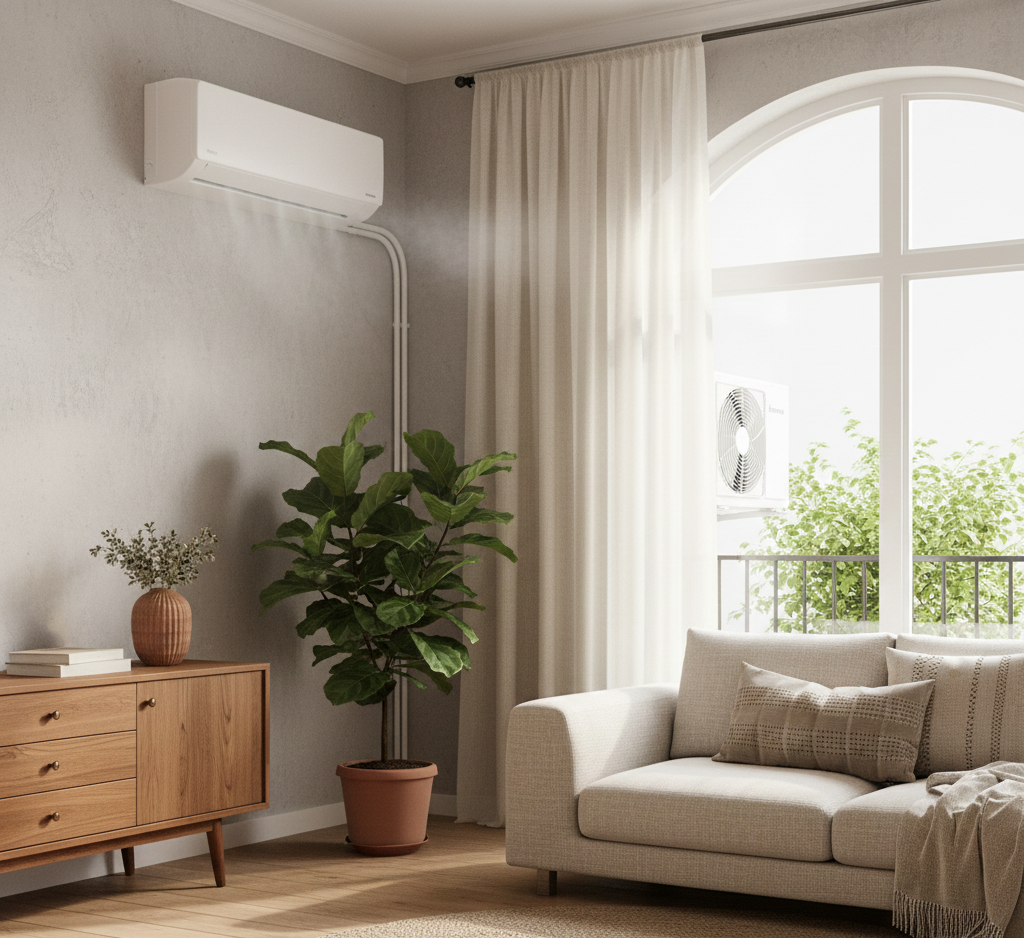
- Curtains on the unit
- Big-sized furniture obstructing the sides
- Wall panels with décor above the unit
The consequences:
- Inconsistent cooling
- High pockets of hot air
- Higher rate of cooling – A case for reduced cooling
- Higher consumption of electricity
Enhanced airflow configuration:
- Keep a gap of around 1.5-2 feet around the AC
- 4-Way Swing shall not be hindered
- Do not place the AC on top of heavy furniture.
Well-ventilated areas cool faster and use less power.
5.Unhealthy Filters and Poor Maintenance
Higher floors tend to trap more dust and smaller particles. As a result, filters clog more easily and work the compressor harder.
Problems may arise from dirty filters:
- Poor airflow
- Offensive smells
- Longer cooling times
- 10-20% increase in power consumption
Best maintenance routine:
- Clean filters every 15-20 days during summer
- do one deep service before peak summer
- Clean the outside unit every 4-6 months
A cleaner filter means cleaner air and reduced electricity costs.
6.Window Heat and Sunlight
“Even with a powerful air conditioner, the sun can overpower through the window, causing the temperature to rise by as much as 3-4°C.
Common mistakes:
- Thin curtains
- UV protection on glass isn’t necessary –
- Windows not sealed properly
Correct solution:
- Blackout curtains
- UV Protection
- Windows Seals should be filled adequately
Advantages: rapid cooling and reduced heat on the AC.
7.Stabilizer Not Used in Areas with Voltage Fluctuations
Upper floors may experience:
- Resultant Voltage Drops
- Power fluctuations
- Rise during rainy season
Despite this, Stabilizer less Blue Star ACs are widely available and functional; however, this may cause damages on the compressor PCB for big power variations.
Best tip:
In areas with power variations, one should use a good quality Stabilizer to save on costly services.
Final Tips
Neglecting these above-mentioned basic mistakes may lead to:
- Accelerated cooling with increased speed by 30-40%
- Greatly lower one’s electrical energy bills by 30-40%
- Increase AC life by at least 3-5 years
- Stay cool and cool with smooth functions without sudden ac failures on scorching summer afternoons.
Even with the best Blue Star AC for upper floor rooms.
Blue Star vs LG vs Daikin — Top-Floor Comparison
| Criteria | Blue Star | LG | Daikin |
|---|---|---|---|
| Heat management in scorching heat | Bluestar handles Indian summers with utmost ease and is designed for high-ambient use and strong performance. | LG provides good cooling, especially with its inverter models. | Daikin stands out: consistently engineered to cope with high ambient conditions. |
| Inverter compressor quality and control | Blue Star has a competitive inverter line-up with reliable modulation. | LG shines with very good performance, thanks to its Dual Inverter technology that delivers tight control and quick response. | Daikin has long led the field with its track record of high efficiency and precision inverter systems. |
| Service network and availability in India | Blue Star enjoys a strong presence in metros and tier-1 cities, while the coverage is variable by town. | LG has a vast network across urban, semi-urban, and many service centres. | Daikin maintains a strong dealer and service network, especially in major cities. Coverage can be spotty for smaller towns. |
| Estimated Cost of Electricity (1.5-ton, Average Usage) | Blue Star sits in the moderate range-energy efficiency is good on many 5-star inverter models, though it depends on the exact unit. | It tends to be lower to moderate for LG, with Dual Inverter reducing running units under similar use. | Generally, Daikin has the lowest average running costs due to its premium inverter efficiency. |
| Durability and build quality: coils and anti-corrosive features | Blue Star uses copper condensers with anti-corrosive fins and rugged components suited to India’s climate—very good. | LG is also very good with solid build quality, and copper or aluminium condensers depending on the model. | Daikin is great, boasting premium-class components and always very high quality in manufacturing. |
| Noise and comfort inside the space Indoor units | Blue Star are low to moderate in noise, with some of their models being quieter. | LG is usually very quiet, often among the best in consumer tests. | Daikin is also very quiet, noted for near-silent operation—ideal for bedrooms. |
| Who the top-floor buyer should consider | If rugged cooling and value for money in Indian conditions are your priorities, then Blue Star is a good choice. | LG suits buyers seeking smart features, quiet operation, and strong energy efficiency. | Daikin is best for those chasing top inverter efficiency, whisper-quiet performance, and possibly the lowest running costs over time. |
Takeaways
Service availability matters: check local service reviews — national brand reputation is useful, but local service quality varies town to town and can be the deciding factor for top-floor owners who rely on rapid maintenance during peak summer.
If your top-floor room faces extreme heat and you want rugged performance: Blue Star models are purpose-built for Indian ambient conditions and often include anti-corrosion and heavy-duty compressors that help in hot, dusty environments.
If your priority is the absolute lowest running cost with modern inverter tech and quiet operation: Daikin generally leads on inverter efficiency and quietness, which translates into lower monthly electricity in comparable models.
If you want a balance of smart features, strong inverter performance and wide availability: LG’s Dual Inverter line offers excellent control and low noise while providing solid energy savings.
Which Blue Star AC Should You Buy?
Here’s a quick recommendation:
✔ Small room: Blue Star 1 Ton 5 Star Inverter
✔ Medium room: Blue Star 1.5 Ton 5 Star Inverter (Top pick)
✔ Large room: Blue Star 2 Ton 3 Star Inverter
✔ Budget buyers: Blue Star 1.5 Ton Fixed Speed
If your room gets direct sunlight, always go one level higher in tonnage.
Who SHOULD vs Who Should NOT Buy a Blue Star AC for Top Floor Rooms
| ✅ SHOULD Buy If You Are… | ❌ Should NOT Buy If You Are… |
|---|---|
| Living on a top floor with direct sunlight | Living in a ground-floor or shaded room |
| Using AC 8–12 hours daily | Using AC only 1–2 hours occasionally |
| Facing extreme summer heat (45–52°C) | Living in a cool hill station climate |
| Wanting long life (10–12 years) | Planning to replace AC in 2–3 years |
| Living in coastal/high-humidity cities | Living in dry, low-humidity zones |
| Facing voltage fluctuations | Having stable, clean power supply |
| Wanting strong cooling over smart features | Wanting AI, voice control & app automation |
| Renting out property & needing low breakdown risk | Buying only for temporary or backup use |
FAQs – Best Blue Star AC for Top Floor Rooms
1.What tonnage should I pick for a top-floor room?
Generally speaking, a 1.5-ton unit would suffice for mid-sized rooms, while larger top-floor spaces would call for a 2-ton model.
2.Is a 3-star AC sufficient for top-floor rooms?
It can be, but if you’re running the AC more than about 8 hours a day, a 5-star inverter model is a smarter choice.
3.Does the difference in top-floor insulation benefits really matter?
Absolutely, it can. Insulation can cut the room temperature by 3–6°C and help the AC cool down faster.
4.Is Blue Star better than LG or Daikin for top-floor setups?
It performs exceptionally well at high outdoor temperatures and suits Indian heat conditions.
5.Is it necessary to use a stabilizer with a Blue Star AC?
Most models of Blue Star don’t need a stabilizer, but on top floors where voltage fluctuates, getting a stabilizer is the safer bet.