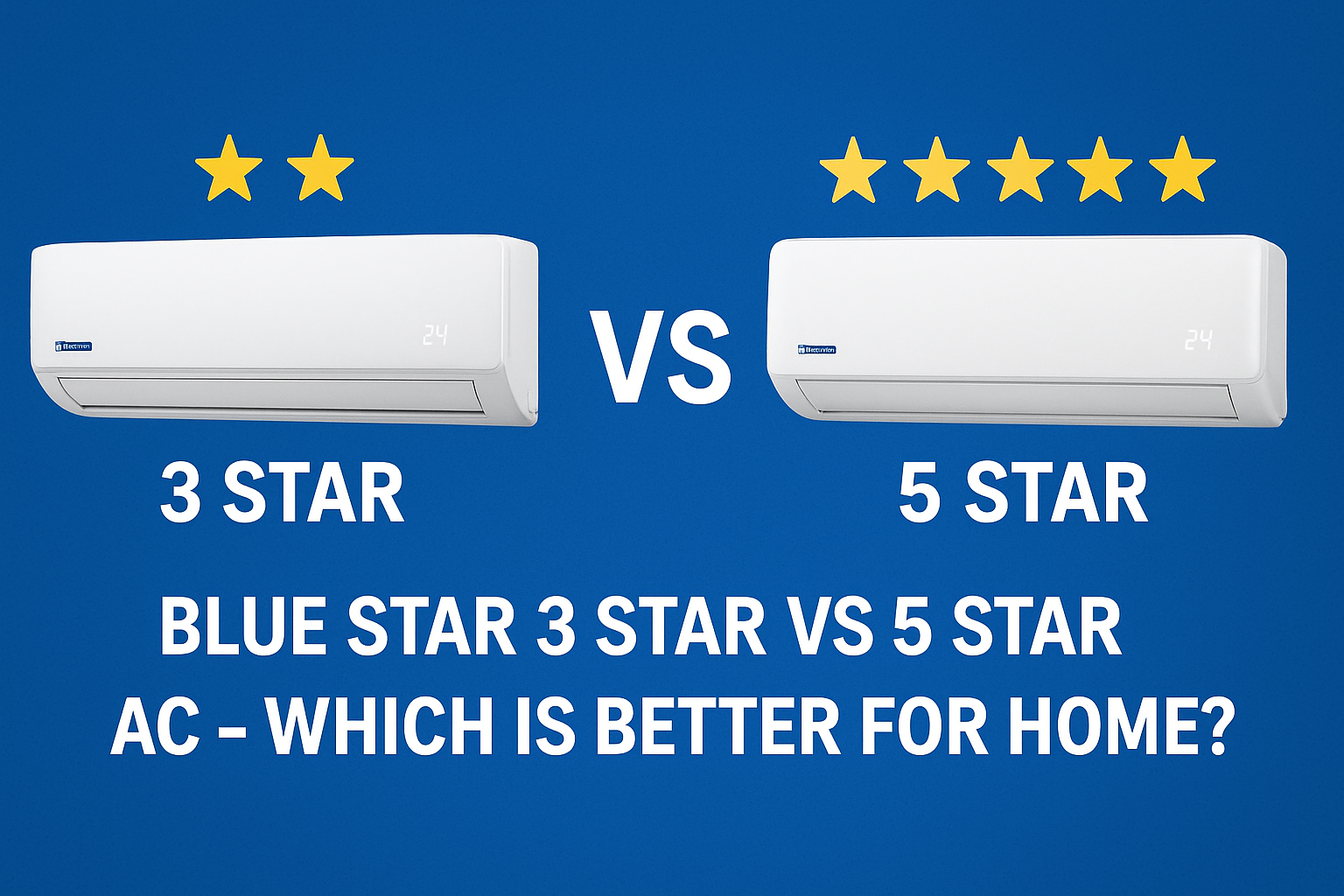
Choosing an air conditioner can be rather perplexing, especially when one is stuck between a Blue Star 3 Star vs 5 Star AC – Which is better for home? With the increase in electricity prices every year and summers getting hotter across India, picking the right energy rating is not just about cooling; rather, it’s about long-term savings, performance, and comfort. Blue Star is one of the most trusted AC brands in India, but the real difference between the company’s 3-star and 5-star models shows up in power consumption, cooling efficiency, and durability.
In the given comprehensive review, we have explained the performances of Blue Star 3 Star and 5 Star ACs under real Indian climate conditions, consumption on electricity bills, needs for maintenance, and value for money. Whether you live in a hot and dry region like Delhi or stay in a humid city like Chennai, this comparison will surely help in finding the perfect AC for your home. By the time you reach the end of this article, you will understand properly which model fits your lifestyle, usage pattern, and budget-so you can enjoy powerful cooling without unnecessary expenses.
What do star ratings really mean? Understanding BEE Star Rating
In India, the amount of electricity consumed by household appliances is measured by the government body called the Bureau of Energy Efficiency. It provides every AC with a star rating from 1 to 5 so that customers can easily choose energy-saving products.
Here’s what it means:
- 1 Star = Least Efficient (highest electricity usage)
- 5 Star: Most efficient (lowest power consumption)
The star rating helps you understand at a glance how much electricity the AC will actually consume. Consider this like the mileage rating given for automobiles: as mileage increases, fuel cost decreases. Thus,
Higher star rating = Better energy mileage of your AC
Every AC also has an ISEER value, which is Indian Seasonal Energy Efficiency Ratio, and it reflects the efficiency of operation of the AC in changing Indian weather conditions.
Higher ISEER = Lower power consumption
5 Star ACs have a much better ISEER as compared to 3 Star ACs.
Why Higher Star Ratings = Higher Savings: An In-depth Explanation
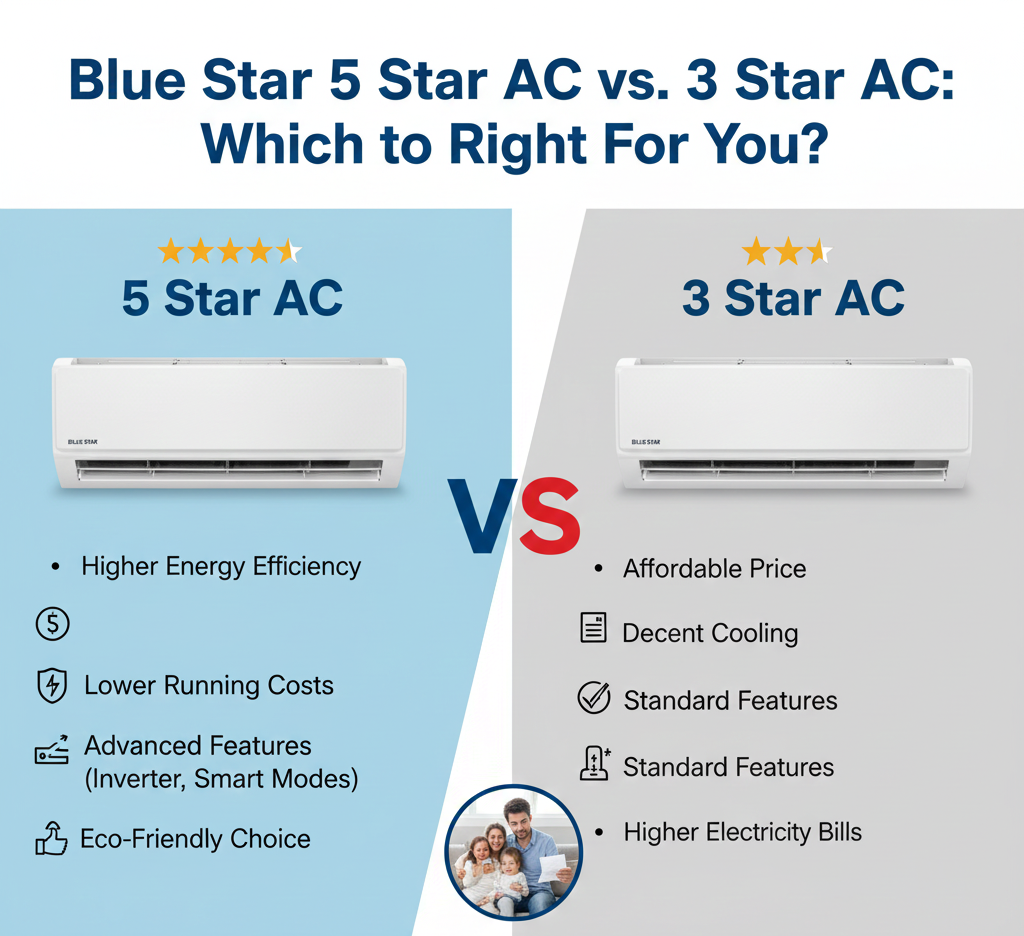
A 5 Star AC saves more electricity because it is built with:
1.Advanced Inverter Compressors
- A 5-star AC would use a variable speed intelligent inverter compressor.
- It adjusts the speed according to room temperature.
- Instead, it runs smoothly at lower speeds instead of turning ON and OFF repeatedly, which is a waste of energy.
This leads to a decrease in electricity consumption of as much as 25%.
2.Heat exchanger enhancements
5 Star ACs generally come with:
- Improved copper coils
- Anti-corrosion coatings
- Better materials for the exchange of heat
- These help the system cool faster using less power.
3.Improved Refrigerant Flow Control
5 Star ACs come with advanced capillary tubes or expansion valves, which:
- Keep cooling stable
- Reduce the load on the compressor
- Avoid energy wastage.
4.Optimized Circuit & Motor Technology
Indoor and outdoor motors of 5 Star models are designed to be more efficient for increased airflow while consuming less energy.
5.Smarter Temperature Management
5 Star ACs maintain the temperature more precisely by using:
- Sensors
- Smart logic
- Smart power distribution
It won’t let overcooling-an extremely common phenomenon among low-rated ACs-drain your electricity.
Simple Example to Understand the Difference
Consider two persons running:
- 3 Star AC Person A runs fast–slow–fast–slow continuously gets tired and uses more energy.
- Person B runs smoothly and evenly, with 5-Star AC, preserving his stamina.
That is exactly how ACs work:
- 3 Star AC = more ON/OFF cycles, more electricity is wasted.
- 5 Star AC = steady, controlled cooling → saves electricity
Real-World Savings You’ll Notice
As a result of these improvements, a 5 Star AC saves approximately 250–300 units annually, compared to a 3 Star AC of the same tonnage.
If electricity costs ₹ 8 per unit:
- 300 units × ₹8 = ₹2,400 saved per year
And if you run AC for 10–12 hours daily, the savings go even higher.
Summary: Why 5 Star Saves More Energy
- Smarter compressor
- Better cooling components
- Fewer ON/OFF cycles
- Cools faster using less power
- Stable operation at extreme temperatures
This is the reason why BEE gives them more stars, for they actually save more electricity throughout their life span.
Differences Between Blue Star 3 Star and 5 Star ACs in Detail
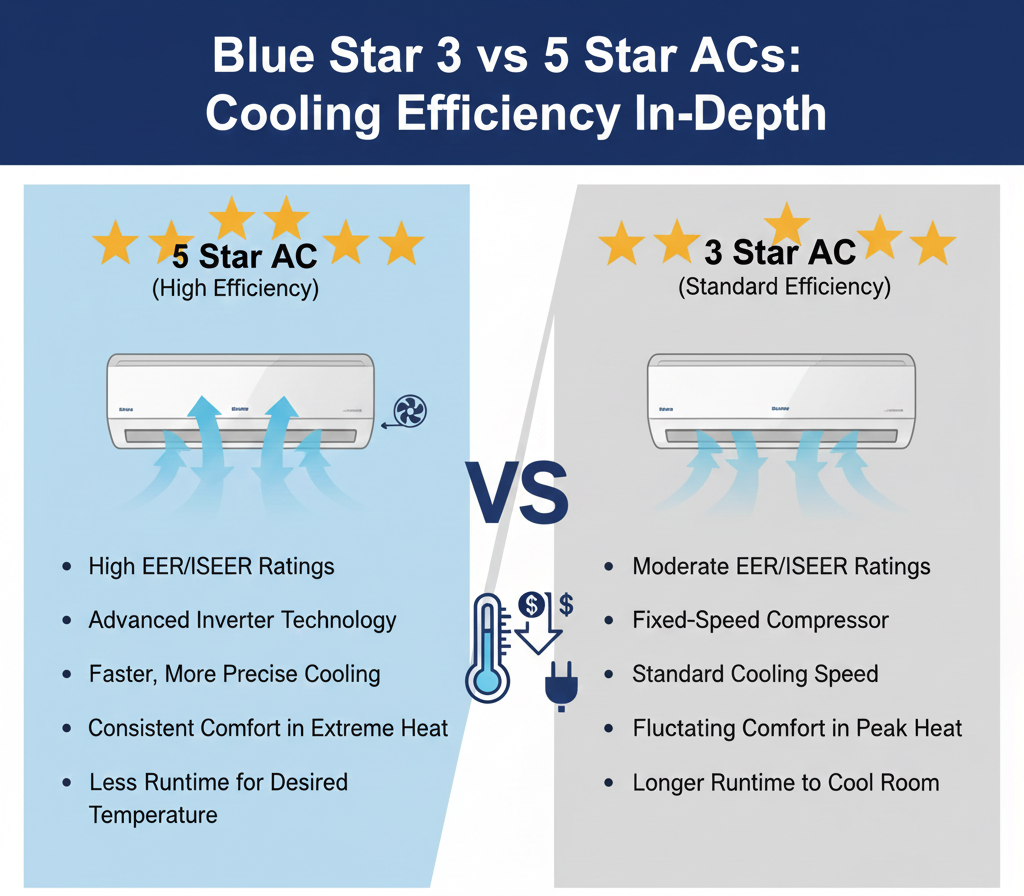
Cooling Efficiency
Both Blue Star 3 Star and 5 Star ACs perform excellently in terms of cooling. Keep them running side by side in one room; the difference in the speed of cooling will not be that noticeable.
However, the real difference appears after the room reaches the set temperature.
How 3 Star AC Cools
- It reaches the set temperature.
- Then the compressor turns OFF.
- When it gets a little warm again, the compressor switches on.
The on/off cycle causes temperature variation and more consumption of electricity.
How 5 Star AC Cools
- It doesn’t switch OFF fully.
- Instead, it reduces compressor speed in order to maintain temperature steadily.
- This keeps the room cool and without sudden warm patches.
This “smooth cooling” uses much less electricity and improves comfort.
In other words,
- 3 Star AC cools well, but consumes more energy to maintain the cooling.
- 5 Star AC cools smarter with fewer power spikes
Power Consumption
This is the biggest difference between 3 Star and 5 Star ACs; this directly influences your electricity bill.
Testing by Blue Star shows that 5 Star models can save up to 25% on electricity compared to similar 3 Star models of the same tonnage.
Here is the comparison of the 1.5 Ton Blue Star Inverter ACs:
| AC Type | Approx. Annual Energy Use |
| Blue Star 3 Star | 1100–1200 kWh |
| Blue Star 5 Star | 850–950 kWh |
That is a difference of 250–300 units annually.
If the cost of electricity = ₹8 per unit:
- 300 units × ₹8 = ₹2,400 saved annually
And if you run AC for longer hours, i.e. 10–12 hrs/day, the savings increase even more-sometimes up to ₹3,000–₹4,000 per year.
Advantages of Inverter Technology
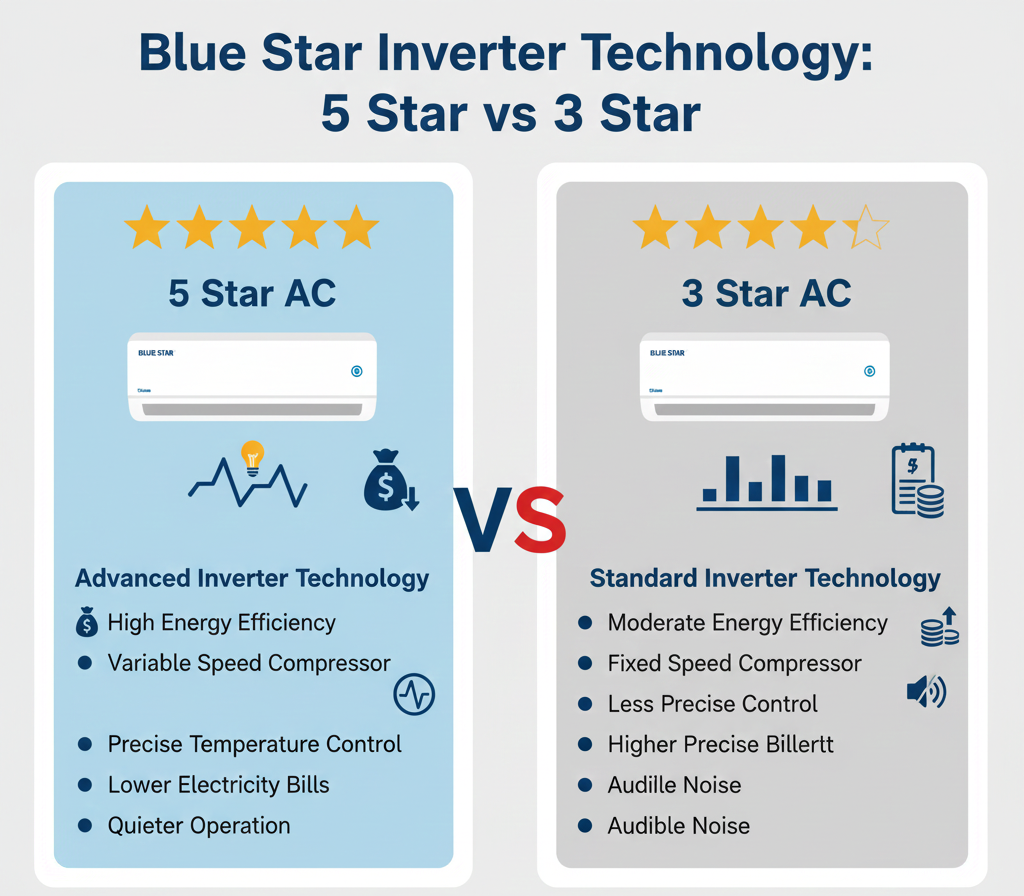
Both 3 Star and 5 Star Blue Star ACs come equipped with inverter compressors, though the technology inside is different.
1.Variable Speed Range
- 3 Star AC compresses air in limited speed steps
- Example: low, medium, high
- 5 Star AC has a wider speed range.
- Example: 10+ speed levels
This allows the 5 Star AC to more accurately match the cooling demand.
2.Intelligent Energy Control
5 Star Blue Star ACs come equipped with advanced microprocessors and sensors that enable:
- Compressor speed
- Fan speed
- Refrigerant flow
- Indoor temperature detection
Such smarter logic greatly reduces power wastage.
They come with inverter control; however, the algorithm in 3 Star ACs is simpler and less accurate.
3.Performance in extreme temperatures
A big plus:
- 5 Star ACs maintain efficiency even when outdoor temperature crosses 45°C
- 3-star ACs perform worse in more extreme heat, using more electricity to cooling
4.Life-span and durability
This reduces the stress on the 5 Star AC compressor because it can avoid frequent ON/OFF cycles, thereby increasing its life.
Real-life Example to Understand the Difference
Imagine driving in the city:
- 3 Star AC = stop-and-go traffic
- More fuel is wasted by constant stopping and accelerating.
- 5 Star AC = highway driving with smoothness
- Cruising at the same speed burns less fuel.
That is precisely how AC compressors work.
Bottom Line
- Cooling: Both cool well, but 5 Star maintains temperature more smoothly
- Electricity Use: 5 Star uses 250–300 fewer units per year
- Technology: 5 Star has smarter inverter logic and wider speed control.
- Best For: People who use AC for long hours
More Elaborate Version: Energy-Detailed Comparison
Here, the major variation, comparing Blue Star 3 Star vs 5 Star ACs, lies in the area of their power consumption for one year. The rating in terms of the number of stars directly influences how much money you pay to get electricity, especially if you keep your AC running for extended hours or live in a very hot region.
Let us break it down now, clearly.
Annual Energy Consumption (kWh)
Following is a general comparison in the case of a 1.5 Ton Blue Star Inverter AC, which is a common size in Indian homes:
| Rating | Approx. Annual Electricity Consumption |
| 3 Star | 1100–1200 kWh per year |
| 5 Star | 850–950 kWh per year |
Therefore, an average 5 Star AC will consume around 250–300 less units every year compared to the consumption by a 3 Star AC.
Why the difference?
Because of a 5 Star AC:
- Runs the compressor at an optimized speed.
- Smoothes temperature fluctuations
- Avoids heavy peak power usage
- Cools efficiently even in higher outdoor temperatures
These small improvements translate into big savings annually.
Approximate Yearly Electricity Bill Comparison
The above comparison can be made more comprehensible if the cost of electricity is considered at ₹ 8 per unit, which is an average prevailing rate in many Indian states.
Now, let’s compare the power bills of two different usage patterns.
With 8 Hours Daily Usage
Example: For use at night only
| Rating | Annual Units Used | Yearly Electricity Bill |
| 3 Star | ~1150 units | 9,2005 |
| 5 Star | ~900 units | ₹7,200 |
Annual Savings: ~₹2,000
- Ideal for those people who use air conditioning only at night.
- A 5-star AC indeed gives definite savings even on moderate usage.
With 12 Hours Daily Usage
Example: Day + Night usage or hot regions
| Rating | Annual Units Used | Yearly Electricity Bill |
| 3 Star | ~1500 units | ₹12,000 |
| 5 Star | ~1100 units | ₹8,800 |
Annual Savings: ₹3,000+
If you use AC for half of the day routinely:
- It is a fact that a 5-star AC saves ₹3,000-₹4,000 every year.
- Savings over 5 years ₹15,000+ You save ₹ 30,000–40,000
- over more than 10 years, which is the average lifespan of an AC!
This more than compensates for its higher upfront cost.
Savings: A Real World Example
Let me compare that with driving:
- A 3 Star AC is like a car that gives 12 km/l mileage.
- A 5 Star AC is like a car that gives 18 km/l mileage.
While both cars run from A to B, one is burning more fuel.
Same with ACs, while both cool your room, one wastes more electricity.
Bottom Line of Energy Comparison
- Light user (6–8 hrs/day) → 5 Star saves ₹2,000/yr
- Heavy user (10–12 hrs/day) → 5 Star saves ₹3,500–₹4,000/year
- Long-term use → 5 Star becomes significantly cheaper
Upfront Cost Difference
Blue Star 5 Star ACs are normally priced ₹5,000 to ₹10,000 more than 3 Star models.
You might think:
“Why should I pay extra now?”
Here’s why.
Is 5 Star really worth the added expense?
Of course, provided your use is high enough.
If you run the AC 6–10 hours daily, the savings add up month after month, and the AC pays for itself.
But if your usage is confined to 1-3 hours a day, then a 3 Star AC would serve the purpose.
Long-Term Savings Explained
Payback Period
Let’s assume the price difference is ₹8,000.
With annual savings of ₹2,000–₹3,000:
- Break-even in 2–3 years
- After that, it’s pure savings.
- 5 Star ACs have their lifetimes extended.
Who Should Buy a 5 Star AC?
Choose 5 Star if you:
- Run AC for 8–12 hours daily
- Live in hot cities like Delhi, Chennai, Hyderabad, Nagpur
- Want the lowest possible electricity bill
- Prefer long-term savings over upfront cost
Who Should Prefer a 3 Star AC?
Go for 3 Star if you:
- Use AC for 2-4 hours daily
- Live in moderate climate cities
- Want affordable pricing
- Not running AC overnight
Performance under Indian Climatic Conditions
The weather in India is extreme, with summers being really hot, humidity around coastal areas sticky, and seasonal variations heavy. All these put together make the performance difference between the Blue Star 3 Star and 5 Star ACs all the more distinctive compared to countries with a cooler climate.
Now, let’s see how each of them performs under regular Indian weather conditions.
Peak Summer Performance (High Heat Conditions)
The temperatures, during Indian summers, normally reach 40–45°C in most cities. And this is where 5 Star ACs show their clear advantage.
5 Star Models: Built for Extreme Heat
- They also maintain the set temperature more precisely even when the outdoor unit is subjected to very high temperatures.
- Advanced inverter compressors prevent overheating and consume less energy under stress.
- With this efficient heat exchange, the AC cools down the room faster without consuming too much power.
- They don’t “struggle” keeping the room cool during peak afternoon hours.
That just means the 5 Star AC will function correctly and efficiently, even under extreme conditions of hot sun.
3 Star Models: Higher energy consumption in heat
- 3-star ACs have to work harder and run longer for the same degree of coolness.
- This leads to:
- Higher electricity consumption
- More compressor load
- Slower cooling during peak heat
- Especially between 1 PM – 4 PM, the changes in temperature can be felt more.
That means, for cities that have a heavier summer, such as Delhi, Jaipur, Nagpur, and Hyderabad, the performance of a 5-star AC is way better.
Humid Climate Performance [Coastal Areas}
The other major factor in India is humidity. All through the year, the cities of Mumbai, Chennai, Kerala coastal towns, and Kolkata have high levels of moisture.
It is humidity that makes the air feel hotter than it actually is. An AC’s job is not only to cool but also to remove moisture efficiently.
Performance of 5 Star Blue Star ACs
- They are also fitted with more advanced moisture removal capabilities.
- Their continuous compressor operation provides steady, rather than temporary, dehumidification.
- Result:
- Quicker cooling
- Less sticky
- Electricity consumption reduced
- Rooms also feel more comfortable at settings even at 26–27°C, with the humidity well-controlled.
That means you don’t have to keep lowering the temperature, which in turn saves more electricity.
How 3 Star Models Perform Under Humidity
- They do remove humidity, but not as effectively.
- Inconsistent moisture control due to frequent ON/OFF cycles.
- You might sense that the room has become cold, while it is still sticky.
- Generally, people lower the temperature to 23-24°C, which increases the power bill.
- A 5 Star AC will make a marked difference in comfort and cost for dehumidification in humid regions.
Summary: Which Performs Better in Indian Climate?
| Climate Type | Best Performer | Why |
| Extreme Heat (40–45°C) | 5 Star | Efficient cooling, less power consumption, consistent performance |
| Humid Climate | 5 Star | Better humidity control, faster comfort cooling |
| Moderate Weather | Both | 5 Star still saves more electricity |
Comparison of Maintenance & Durability
While investing in an AC, it’s not a question of either upfront cost or electricity bills; rather, maintenance, durability, and long-term performance are equally important, and that’s where the notable differences between Blue Star 3 Star and 5 Star ACs come in.
Compressor Life
Since the compressor is the heart of an AC, its health directly affects both the performance in cooling and the lifetime of the AC.
5 Star ACs: Superior Compressor Technology
All Blue Star 5 Star ACs employ these variable-speed inverter compressors that run at variable speeds depending upon the demand for cooling, thus avoiding undue stress.
Key benefits:
Less heat produced
Since the compressor does not ON/OFF frequently, it remains cooler and lasts longer.
Better internal components
5 Star models have advanced coils, precision sensors, and an overall mechanism of refrigerant flow.
Reduced wear and tear
Operating at controlled instead of full speeds translates into a compressor’s lifetime being extended accordingly and logically.
Assuming proper servicing, the compressor of a 5-star AC would last 2-3 years longer than that of a 3-star one.
3 Star ACs: Sufficient but not so efficient
While 3 Star units do use inverter compressors, the range of speed and efficiency levels is lower. They tend to:
- Run hotter
- Experience more on/off cycles frequently
- They have to bear more stress during peak summers.
This reduces compressor life as compared to 5 Star units.
Service Requirements
Regarding servicing, the basic servicing requirement is the same for 3 Star and 5 Star ACs, which are as follows:
- Cleaning of filters every 15–30 days
- Refrigerant level checking
- Servicing Coils
- Outdoor unit airflow check
Performance differs with neglected maintenance.
5 Star ACs handle neglect better:
efficiency is not much reduced if there is moderately clogged filter or lightly covered coil due to dust accumulation. The compensatory effect in cooling comes through the combined effort of inbuilt sophisticated sensors and inverter logic.
3 Star ACs: lose their efficiency much faster.
Even slight dust accumulation in the coil makes the compressor work harder, leading to: Higher power consumption Slower cooling Increased compressor strain
Which One Is Better for Your Home?
Apartment Users
If you live in:
- Flats with moderate sunlight exposure
- Use AC mainly at night
→ 3 Star is a good choice.
Independent House Users
If you live in:
- Top floors
- Houses with direct sunlight
- Large rooms
→ 5 Star is the best choice.
check out our How to Choose the Right Blue Star AC article for more details.
Final Verdict
If your main aim is saving on electricity, then it’s obvious who the winner is.
The immediate takeaways with Blue Star 5-star ACs are that they consume lesser electricity, save more money in the long run, and perform much better during the torrid Indian summers.
But if you use AC only for a couple of hours a day, the 3 Star Blue Star gives good value without burning your budget.
Bottom line:
- Heavy users → Go for 5 Star
- Light users → 3 Star is sufficient Anyway,
Blue Star ensures the best in class cooling & longevity.
FAQs
1.Do Blue Star 3 Star and 5 Star ACs cool the same?
Yes, both cool equally well. The difference is in electricity consumption, not cooling power.
2.How much can I save with a Blue Star 5 Star AC in a year?
Cost: Usually ₹2,000–₹4,000 depending upon usage hours.
3.Is the 5 Star AC worth the extra money?
Yes, if your daily usage is above 6 hours. You recover the cost in 2–3 years.
4.Does 5 Star AC last longer?
Usually yes, because the compressor works less hard in comparison to a 3 Star AC.
5.Can a 3 Star AC be used for overnight cooling?
Yes, but it will consume more electricity than a 5 Star AC.