A stable and accurate power supply is the major factor in the performance of your air conditioner. If you have a Blue Star Air Conditioner or are planning to buy one, it is important to note that it requires the right voltage. Applying the wrong voltage can lead to reduced performance of your air conditioner, frequent break downs, damage to your PCB, or complete failure of the ac.
This article discusses the correct voltage requirements for Bluestar ACs, voltage fluctuation explanations, requirements for a stabilizer, as well as tips for ensuring power conditions remain safe, designed for end-users.
Which is the ideal voltage for Blue Star AC?
Blue Star air conditioners in India are made in a manner that they can function with the normal power supply of a home.
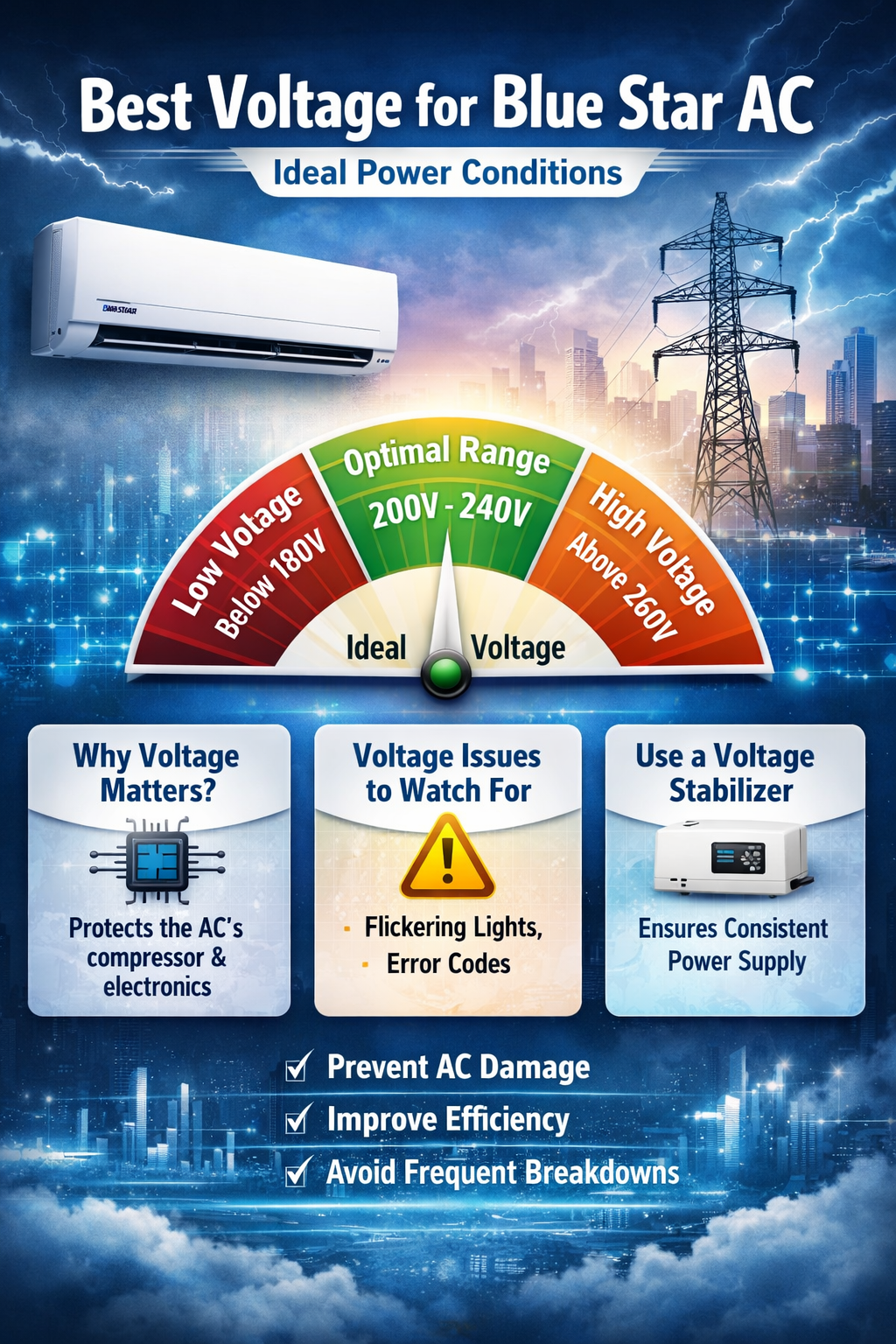
Operating voltage: 220V – 240V single phase
Adhering to this interval is beneficial for:
- Smooth compressor operation
- Coolness efficiency
- Use less electricity
- Longer life for internal components
The best performance can be achieved when maintained within this range.
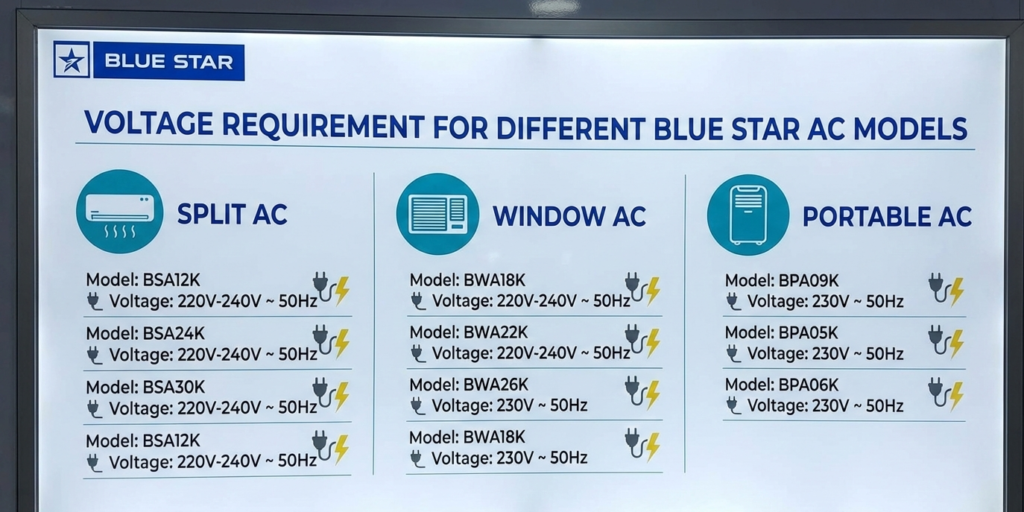
Voltage Requirement for Different Blue Star AC Models
Blue Star AC voltage tolerance can vary minutely depending on the type, as it is led by the technology integrated into it. This is important to know to avoid bugs.
Blue Star Inverter Split AC
The units are able to accommodate a broader range of voltages owing to their sophisticated printed circuit board and variable speed compressors.
- Ideal Voltage: 220V–240V
- Safe Operating Range: 160V–270V
- Stabilizer Requirement: Generally not required
Why it matters: This auto-adjusting compressor ensures optimal performance despite dips or surges in voltage.
Blue Star Fixed-Speed (Non-Inverter) Split AC
Those that do not have an inverter require a more stable voltage supply because the compressor operates at fixed speeds.
- Ideal Voltage: 220V–240V
- Safe Operating Range: 180V–250V
- Stabilizer Requirement: Recommended
Why It Matters: Both low and high voltages can cause trip-offs and inhibit cooling.
Blue Star Window AC
Window models are less tolerant compared to split models.
- Ideal Voltage: 220V–240V
- Safe Operating Range: 190V–250V
- Stabilizer Requirement: Strongly recommended
The reason why it is important: The function of the stabilizer is to guard against damaging the compressor and the PCB. Voltage tolerance also differs by AC type—compare stability and performance in our Blue Star split vs window AC guide.
Voltage Operating Range of Blue Star ACs
Voltage operating range for Blue Star ACs In most of the newer Blue Star units, some variation is to be expected, but the permissible amount depends on the model.
| Blue Star AC Type | Ideal Voltage | Working Voltage Range |
|---|---|---|
| Inverter Split AC | 220–240V | 160–270V |
| Fixed-Speed Split AC | 220–240V | 180–250V |
| Window AC | 220–240V | 190–250V |
The exact voltage range should always be looked upon in the user manual of your model.
Does Low or High Voltage Increase Electricity Consumption?
Yes, voltage fluctuations can directly impact electricity consumption and overall AC performance.
Effect of Low Voltage on Power Consumption
When voltage is low, the AC draws higher current to maintain cooling. This results in:
- Increased power consumption
- Higher electricity bills
- Excessive heating of wiring and components
- Reduced compressor life
Effect of High Voltage on Power Consumption
High voltage forces electrical components to operate beyond their rated capacity, causing:
- Energy wastage
- Overheating of PCB and motors
- Risk of sudden breakdown
Maintaining voltage within the recommended range helps your Blue Star AC operate efficiently while keeping electricity bills under control. Voltage fluctuations can also increase electricity bills—learn how to reduce power usage in our detailed guide on Blue Star AC power consumption and electricity saving tips.
Does Blue Star AC Have Built-In Voltage Protection?
Yes. Most modern Blue Star ACs, especially inverter models, come with built-in voltage protection features.
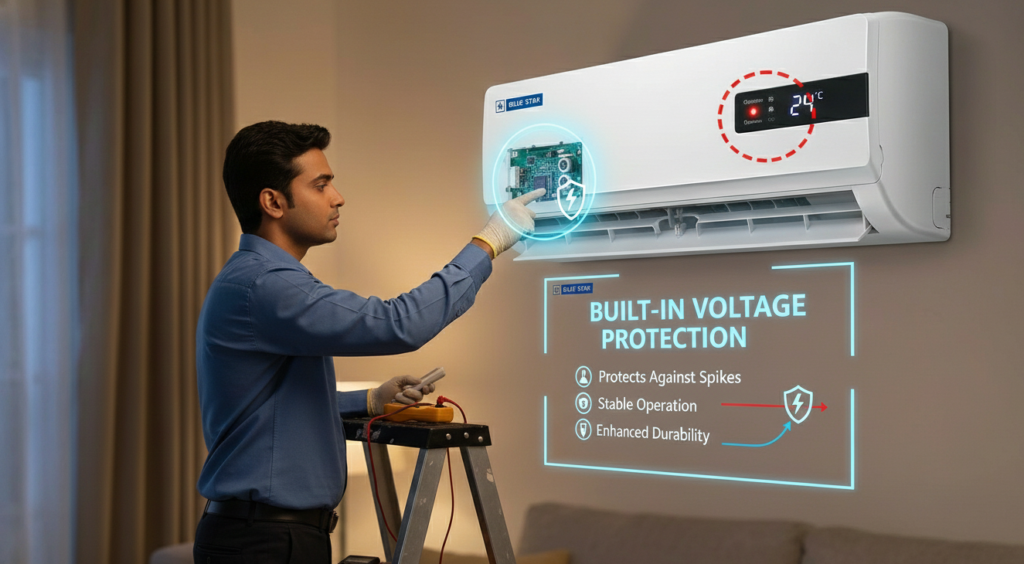
Built-in Safety Features Include:
- Automatic shutdown during extreme voltage fluctuations
- Compressor delay protection
- Self-diagnosis and error indication
However, built-in protection has limits and cannot handle extreme or frequent voltage swings.
Blue Star AC Voltage-Related Error Codes & Indications
Blue Star air conditioners have safety features that sense irregular voltage conditions and protect the internal parts.
Various Symptoms Associated with Voltage Issues
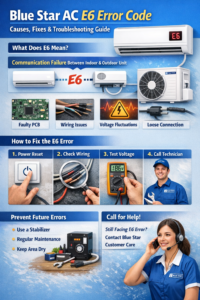
- Indoor unit operates but outdoor unit does not turn on
- LED flashes constantly
- The AC switches OFF automatically after start-up
- Display panel with indications of errors (model-specific)
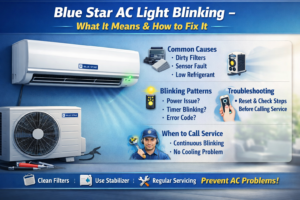
These are normally an indication of voltage levels outside the normal operational limit. The AC switches off in order not to damage the compressor or the PCB. This is because the AC will restart normally once the voltages are stable. If your AC shows flashing indicators, check out our complete guide on Blue Star AC light blinking and what it means to identify voltage-related issues early.
Blue Star AC Voltage Range Compared to Other AC Brands
Given below is a comparison of the voltage tolerance offered by various popular AC brands available in India:
| AC Brand | Ideal Voltage | Operating Voltage Range |
|---|---|---|
| Blue Star | 220–240V | 160–270V (Inverter) |
| LG | 220–240V | 145–290V (Inverter) |
| Daikin | 220–240V | 160–270V |
| Voltas | 220–240V | 150–280V |
Blue Star ACs come with a good ability to cope with voltages, which is apt for the Indian market.
Standard Household Voltage in India for Air Conditioners
As per Indian electricity standards, the nominal household voltage supplied in India is 230V ±10%.
This means that voltage can range from 207V to 253V. under normal conditions. Blue Star ACs are designed to operate efficiently within this national voltage standard, with inverter models offering even wider tolerance for added safety.
Is a Stabilizer Needed in Blue Star AC?
Stabilizer not required when:
- You are using a Blue Star Inverter AC
- Voltage range for your region is 160V–270V
- Power Supply: Stable due to metro cities, good infrastructure
Stabilizer Recommended When:
- Repeated instances of voltage fluctuations exist
- Voltage can sometimes drop below 160V
- You have a rural or semi-urban background
- Wiring is old or overloaded
Recommended Stabilizer Capacity
- 1-1.5 Ton AC: 4 kVA – 5
- 2 Ton AC: 5 kVA – 6 kVA
The addition of a stabilizer in your AC can increase its life.
Is the Use of Stabilizers Covered by Blue Star Warranty?
Blue Star suggests that in places where the power supply varies, it is always best to use a stabilizer. The warranty may not necessarily protect damage that could be caused by extreme voltage variations when proper precautions are not taken.
Using a stabilizer helps:
- Protect warranty validity
- Prevent costly PCB or compressor repairs
- Improve long-term reliability
How to Check Voltage at Home
You can easily monitor voltage using:
- Digital voltmeter
- AC stabilizer with LED display
- Smart plugs with voltage monitoring
Ideal voltage reading while AC is running: 220V–240V
Can Blue Star AC Run on Home Inverter or UPS?
Blue Star ACs are not recommended to run on standard home inverters or UPS systems due to high power requirements.
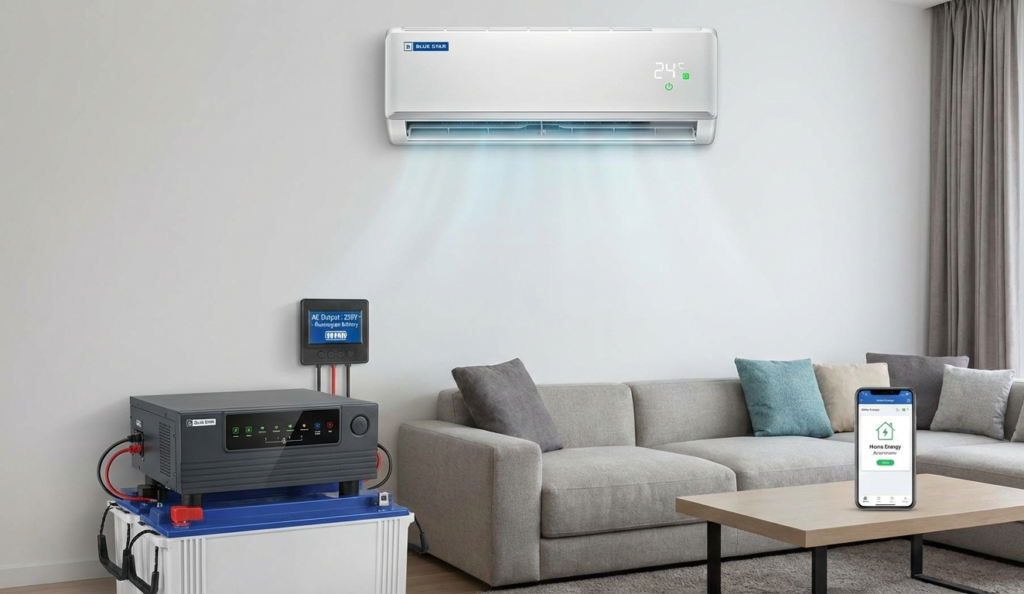
Important Points:
- AC compressors require high start-up current
- Small inverters may get overloaded
- Risk of inverter damage or AC malfunction
Only high-capacity solar inverters or dedicated AC backup systems should be used if power backup is required.
Common Signs of Voltage Issues in Blue Star AC
Watch for these warning signs:
- AC turns ON but compressor doesn’t start
- LED blinking or error indication
- AC shuts down during peak hours
- Outdoor unit not responding
These symptoms often indicate unsafe voltage conditions.
Does Voltage Fluctuation Affect Blue Star AC Cooling?
Yes, unstable voltage can significantly reduce cooling performance.
- Low voltage leads to weak compressor operation
- Cooling becomes slow or uneven
- AC may shut down during peak load hours
Stable voltage ensures consistent cooling, faster temperature drop, and efficient operation.
Tips to Maintain Ideal Power Conditions for Blue Star AC
- Use a dedicated power socket for the AC
- Avoid sharing AC power line with heavy appliances
- Ensure proper earthing
- Use a high-quality stabilizer if required
- Service the AC regularly
FAQs – Best Voltage for Blue Star AC
1.Can Blue Star AC work at 150 volts?
No. Most Blue Star ACs will automatically shut down to prevent damage at such low voltage.
2.What voltage is best for Blue Star inverter AC?
The ideal voltage is 220V–240V, although inverter ACs can tolerate wider fluctuations.
3.Is stabilizer compulsory for Blue Star inverter AC?
Not compulsory, but strongly recommended in areas with unstable power supply.
4.Can voltage fluctuation damage Blue Star AC PCB?
Yes. Continuous voltage fluctuation is a major cause of PCB failure.
Final Verdict: Best Voltage for Blue Star AC
For safe operation, efficient cooling, and long AC life:
- Ideal Voltage: 220V–240V
- Safe Operating Range: As specified by your model (usually 160V–270V for inverter ACs)
If voltage fluctuations are common in your area, investing in a good stabilizer is far cheaper than repairing or replacing damaged AC components.
Maintaining the right voltage conditions ensures your Blue Star AC delivers powerful cooling, lower electricity bills, and reliable performance for years to come.