

Selecting the right AC tonnage is as bewildering as it can get, isn’t it? You go to a shop, and the salesman uses words like 1 Ton, 1.5 Ton, 2 Ton — but what do such terms mean, really? Particularly when you’re investing in a brand like Blue Star, knowing about AC tonnage is the way to cooling comfort and cost-effectiveness.
What is AC Tonnage?
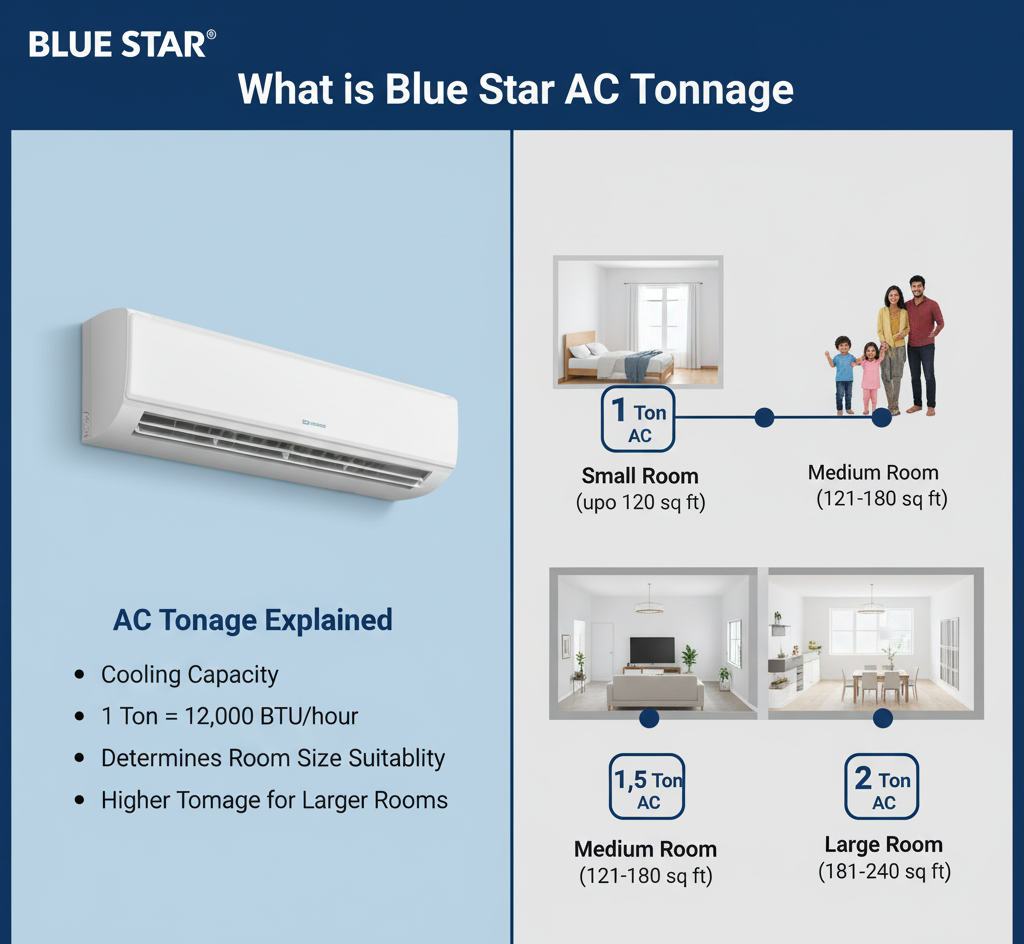
Understanding Blue Star AC Tonnage means knowing the cooling capacity of an air conditioner. It indicates how much heat the unit can remove from a room in an hour. The term ‘ton’ in this context harks back to the amount of heat required to melt one ton (approximately 907 kilograms) of ice over a 24-hour period. So, a ‘1 Ton’ AC can dissipate that amount of heat in a day.
Breaking Down the Numbers
- 1 Ton AC: Removes 12,000 BTUs (British Thermal Units) of heat per hour.
- 1.5 Ton AC: Removes 18,000 BTUs of heat per hour.
- 2 Ton AC: Removes 24,000 BTUs of heat per hour.
These numbers are key when Understanding Blue Star AC Tonnage and its impact on cooling performance.
Why Does Tonnage Matter?
Choosing the right tonnage is crucial for efficient cooling and energy consumption. An undersized AC will struggle to cool your space, running continuously and hiking up your electricity bill. Conversely, an oversized AC will cool the room too quickly without properly dehumidifying, leading to a cold yet clammy environment. Properly Understanding Blue Star AC Tonnage ensures you get the best performance while keeping energy bills in check.
Factors Influencing Tonnage Selection
When Understanding Blue Star AC Tonnage, consider these factors to select the right capacity for your space:
- Room Size: Larger rooms require higher tonnage to ensure effective cooling. Check out this article Best 4 Blue Star AC Models for Small Rooms to find the best blue star ac for your room.
- Ceiling Height: Rooms with higher ceilings have more air volume, necessitating greater cooling capacity.
- Insulation Quality: Well-insulated rooms retain cool air better, potentially reducing the required tonnage.
- Sun Exposure: Rooms with significant sun exposure, especially during peak hours, may need a higher tonnage AC to combat the additional heat.
- Occupancy and Appliances: Spaces with more people or heat-generating appliances might demand increased cooling capacity.
Understanding Blue Star AC Tonnage helps you balance these factors to pick the right model.
How Blue Star Defines AC Tonnage
Tonnage and BTU Explained
Blue Star, India’s most reliable AC brand, positions tonnage exactly where BTU output and compressor efficiency come into play. As an example, Blue Star 1 Ton Split AC delivers approximately 3.5 kW of cooling capacity that is ideal for small-sized rooms.
Blue Star’s Efficiency Standards
Each Blue Star AC is rated with ISEER (Indian Seasonal Energy Efficiency Ratio) — a measure of efficiency with which it converts electricity to cooling. Better ISEER = better efficiency, even at the same tonnage.
Choosing the Right Tonnage for Your Room
Getting the tonnage wrong is one of the most common — and costly — mistakes that consumers make when purchasing an air conditioner. Using the wrong capacity can lead to poor cooling, higher electricity bills, and even shorter life for the AC. So let’s make sure you get it right the first time.
In choosing the appropriate Blue Star AC tonnage, aside from your room space, you also need to look at aspects such as exposure to sunlight, insulation factor, and average number of occupants of the room. Below is an easy-to-adhere-to guideline to assist you in your decision-making:
Small Rooms (120 sq. ft. and below)
Recommended tonnage: 1 Ton AC
A Blue Star 1 Ton AC would be ideal for small bed rooms, kids’ rooms, study rooms, or home office.
Since these rooms have a limited volume of air, a small 1 Ton unit would be efficient enough in cooling them without using much energy.
If your small room gets direct sunlight in the afternoon or has large windows, use a 1 Ton inverter AC instead of a non-inverter. The variable speed temperature of the inverter compressor provides consistent cooling coupled with power saving.
Medium Rooms (120–180 sq. ft.)
Suggested tonnage: 1.5 Ton AC
It is the best selling option for Indian homes, particularly for master bedrooms and small living rooms.
A Blue Star 1.5 Ton AC provides the ideal combination of high-performance cooling and power efficiency.
It can easily cope with moderate heat load — whether it is operating a ceiling fan alongside or the AC during the peak summer season.
Product variants such as Blue Star IA318YNU or FS318EBTU provide sophisticated inverter technology, providing consistent cooling even when temperatures reach above 40°C.
Real-life scenario
Where you reside in a city like Chennai, Delhi, or Mumbai — it’s humid and hot there — the 1.5 Ton variant provides quick cooling without burdening the compressor or your electricity bills.
Big Rooms (180–300 sq. ft.)
Optimal tonnage: 2 Ton AC
For spacious living spaces, office spaces, or hall spaces, a 2 Ton Blue Star AC is the ideal option.
It provides even cooling to larger spaces and is able to accommodate higher heat load from multiple occupants, appliances, or glass doors.
You will get feels more even cooling, and the AC will not have to run at full capacity all the time — that extends compressor life.
If your room often has 4–6 persons or gets direct sunlight throughout the day, a 2 Ton model provides quick, robust, and effective performance.
Pro Tip:
Choose a 5-Star Inverter 2 Ton Blue Star AC if electricity usage is a concern. It might cost more initially, but you will save every rupee in the long term.
Example: When 1.5 Ton Trumps 1 Ton
Assume that you have a 140 sq. ft. room which receives direct afternoon sunlight and is not very well-insulated.
On paper, a 1 Ton AC may appear to suffice — but practically, it will not cool much. The compressor will be working full-throttle all the time, consuming more power and tending more towards wear and tear.
Now, if you compare a 1.5 Ton Blue Star AC, day and night difference. Cooling becomes quicker, the compressor does not get stressed, and works silently, and the temperature stays same even on the hottest summer day.
You will also be seeing reduced power bill, since the AC does not need to get stressed to keep the temperature same.
Bottom line
It is always preferable to undersize your tonnage somewhat (in moderation) than to under-size it. Ideally sized Blue Star AC provides maximum comfort, long life, and better energy efficiency.
Factors Influencing Cooling Efficiency
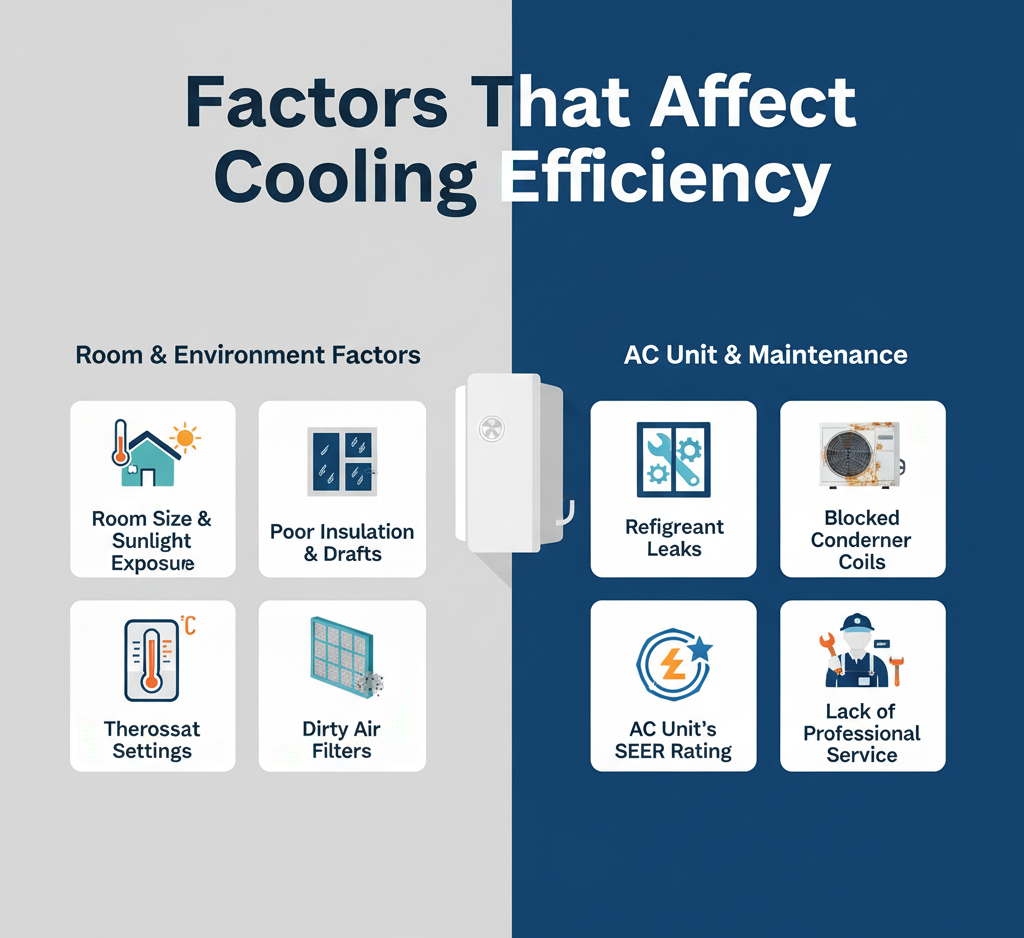
When it comes to air conditioning, tonnage just isn’t the whole picture. Two equally sized rooms can produce drastically different cooling outcomes — all due to variations in their construction, sunlight exposure, or insulation. These outside factors can be the deciding factor for your Blue Star AC’s efficiency.
Let’s discuss the most important factors that contribute significantly to the efficiency with which your AC can cool.
1.Ceiling Height and Room Size
This is the most self-evident — yet most frequently ignored — consideration.
Your AC must chill some volume of air, not floor area. So, open-plan or a high ceiling means more volume of air, and cooling happens more slowly and less effectively.
For example:
A 120 sq. ft. room with a 10-foot ceiling will cool quicker than one with a 14-foot ceiling with the same AC.
In the same vein, if your room shares a common wall or opening with a hallway or another space, cold air leaks out and the AC works harder.
Tip:
If your ceiling is very high, then upgrade somewhat (e.g., from 1 Ton to 1.5 Ton). Also, run ceiling fans to push cool air more efficiently.
2.Occupancy
Each person in a room creates heat — around 300–400 BTU/hour.
So, if you’ve got 4 lying people in a small living room, that’s extra 1200–1600 BTU/hour load which your AC will have to bear.
That’s why an AC which works fine in an unoccupied room might not work as good at parties or when the family is together.
Thumb rule:
If your room gets 3 or more people occupied for the majority of the time, opt for one class higher in tonnage.
Say, if your room size would imply a 1 Ton AC, use a 1.5 Ton Blue Star AC for extra comfort and even cooling.
3.Sunlight and Window Exposure
Natural light is wonderful for mood — not so wonderful for air conditioning!
South- and west-facing rooms get direct sunlight for a few hours, which heats up the indoor space considerably.
Large windows or glass doors contribute to heat gain, particularly if they are not shaded or tinted.
This is what happens to cooling when sun exposure is present:
- A south-facing room will be 2–3°C warmer than the north-facing room.
- During hot summer afternoons, the cooling load can rise by 10–15%.
Solutions:
- Employ thick curtains, blinds, or reflective films on windows.
- Add an additional 0.5 Ton to your AC load if your room is exposed to direct sunlight all day.
- Check Blue Star’s inverter ACs with auto-adjust cooling output depending on heat load.
If your home is on the top floor or receives direct sunlight all day, selecting the best Blue Star AC for top floor rooms can significantly improve cooling performance.
4.Insulation and Type of Walls
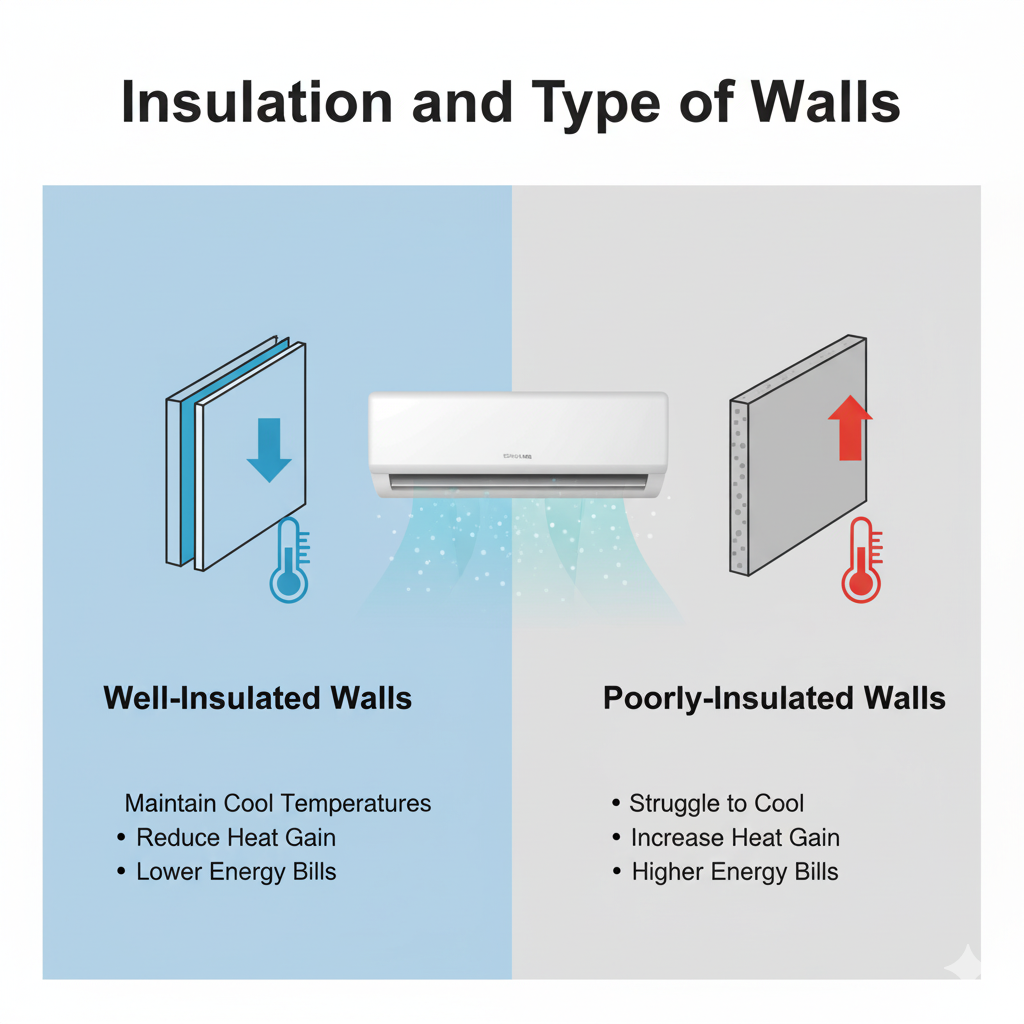
Your walls and ceiling are the “skin” of your room — and their quality decides how fast your space loses or gains heat.
Well-insulated rooms (false ceiling, thicker walls, or roof insulation) retain cool air for a longer period, allowing your AC to cycle off more frequently.
Single-brick or thin walls, however, let outside heat penetrate through to your room in a short time, so your AC will run constantly.
Even the roof comes into play. Top-floor apartments receive more heat due to direct sun exposure, so more cooling capacity is needed.
Quick tip:
- If you’re on the top floor, upgrade by 0.5 Ton from the standard recommendation.
- Apply roof coating or thermal insulation paint to reduce heat absorption.
- Keep windows and doors closed while the AC runs — even small gaps can leak cool air.
5.Electrical Appliances and Lighting
Too often overlooked, things like computers, TVs, or LED lights add additional heat. The more pieces of equipment in use, the hotter it gets.
A light bulb and some computer gear, for instance, can easily produce 400–600 BTU/hour of heat.
Genius tip:
Turn off unnecessary lights and appliances while running the AC. It all adds up to a cozy and consistent temperature — and lowers your electricity bill.
6.Air Circulation and Ventilation
An under-ventilated room will never be evenly cooled, regardless of how strong your AC is.
Clogged vents, shut curtains, or displaced furniture can all impede airflow, causing some rooms to be colder and warmer.
Repair it in an instant:
- Create a gap of 2–3 feet around furniture and air vents or the indoor unit.
- Operate the ceiling fan at low speed to keep cool air circulating.
- Check your AC filters for dirt — dirty filters can reduce airflow by as much as 15%.
7.Humidity Levels
On sea-side locations such as Mumbai or Chennai, humidity puts an unseen burden on your AC.
Your Blue Star AC not only cools the temperature but also eliminates the humidity of the air. Higher humidity equates to your AC compressor running for a longer period to reach both temperature and moisture levels. In high-humidity regions, choosing the best Blue Star AC for coastal areas ensures better moisture control and comfort.
Pro Tip:
Select an inverter model that is equipped with a dehumidifier mode. It will automatically modulate compressor speed and fan level to deliver optimal humidity and comfort.
In Short: The Cooling Equation
To achieve maximum performance from your Blue Star AC, recall this easy dictum:
Efficient Cooling = Right Tonnage + Good Room Conditions
When room design, sunlight, and insulation work with your AC — not against it — you’ll enjoy faster cooling, lower bills, and longer product life.
Popular Blue Star AC Tonnage Options
Blue Star offers a variety of AC models tailored to different cooling needs. Here are a few examples that will help in Understanding Blue Star AC Tonnage:
Blue Star 1 Ton AC
- Best for compact rooms
- Lower power consumption
- Available in both inverter and non-inverter types
- Example: INVERTER SPLIT AC | B SERIES | 1 TON | 3 STAR
Blue Star 1.5 Ton AC
- Most versatile choice
- Ideal for medium-sized Indian bedrooms
- Offers balance between cooling and energy efficiency
- Example: INVERTER SPLIT AC | P SERIES | 1.5 TON | 3 STAR
Blue Star 2 Ton AC
- Heavy-duty cooling for large spaces
- Best for halls, offices, or multi-person rooms
- Available with 5-star inverter variants for top efficiency
- Example: INVERTER SPLIT AC | B SERIES | 2 TON | 5 STAR
Energy Efficiency and Tonnage
Higher tonnage doesn’t automatically mean higher energy consumption. Modern inverter ACs adjust their cooling capacity based on room requirements, optimizing energy use. For instance, a 1.5 Ton inverter AC can modulate its performance, offering both cooling efficiency and energy savings. Understanding Blue Star AC Tonnage also means recognizing the balance between cooling power and energy efficiency.
Split vs Window: Tonnage Efficiency Compared
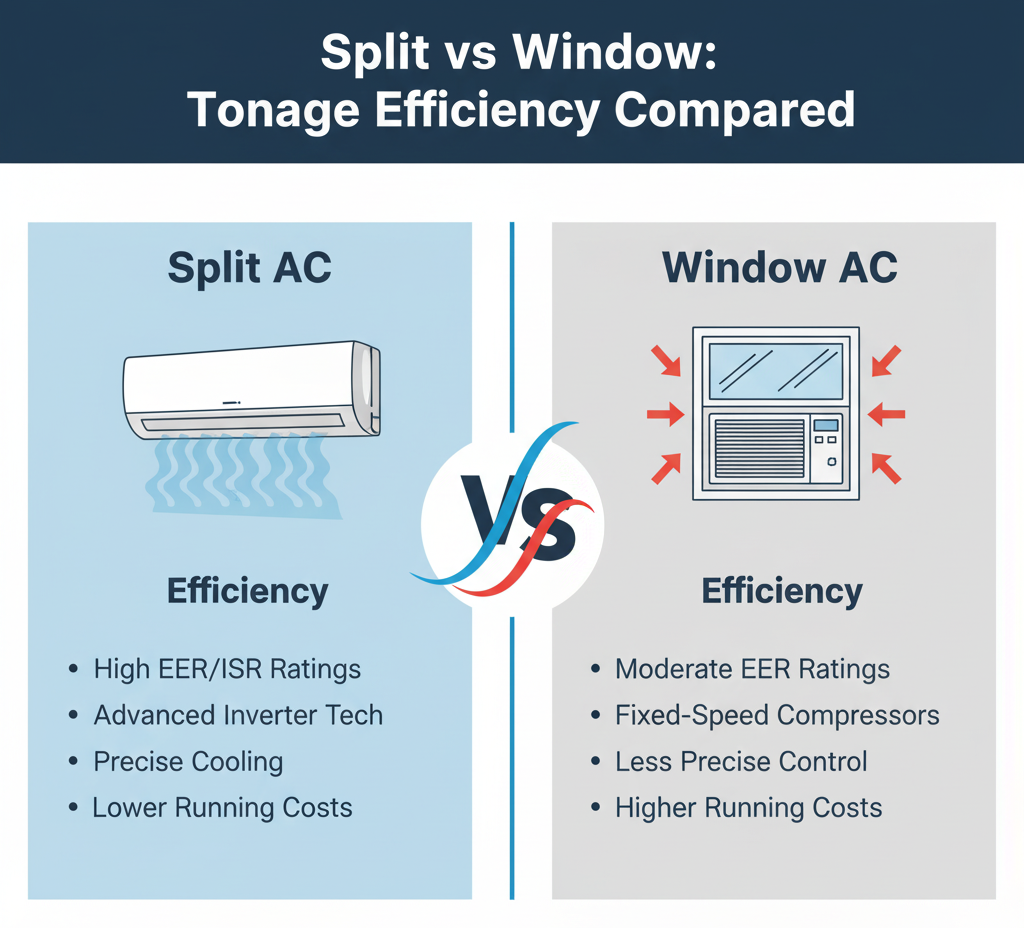
Split ACs and Their Cooling Advantage
Blue Star Split ACs distribute air more uniformly. They’re silent, energy-efficient, and have inverter compressors that dynamically adjust to cooling needs.
Window ACs: Small but Limited
While Window ACs are easier to install and less expensive, they consume more power at bigger tonnage sizes and are not ideal for large rooms.
Comparing Split vs Window: Tonnage Efficiency Overview
| Feature | Blue Star Split AC | Blue Star Window AC |
|---|---|---|
| Cooling Efficiency | Higher (Better air distribution and inverter tech) | Moderate (Limited airflow direction) |
| Noise Level | Very quiet (28–35 dB) | Noticeable (50–55 dB) |
| Energy Consumption | Lower, thanks to inverter compressor | Higher at same tonnage |
| Best Room Size | 100–300 sq. ft. | Up to 150 sq. ft. |
| Installation | Needs indoor/outdoor setup | Simple window installation |
| Maintenance | Slightly higher (two units) | Easier to maintain |
| Cost | Higher initial investment | Budget-friendly |
| Ideal User | Homeowners seeking long-term comfort and efficiency | Tenants or small room users on a budget |
For a detailed comparison, read our Blue Star split vs window AC comparison to understand which type suits your room better.
Inverter Technology and Tonnage Matching
How Inverter Compressors Make Adjustments
Unlike regular compressors which turn on/off continuously, Blue Star inverter ACs also change speed automatically. So even when you choose a slightly higher tonnage, it won’t waste energy — the compressor simply reduces speed once your room has been cooled.
Energy Savings with Properly Sized Tonnage
An appropriately sized inverter AC can help lower electricity usage by 30–40%, especially in urban cities like Chennai or Delhi, which have hot summers.
How to Calculate Ideal Blue Star AC Tonnage
The Simple Formula for Estimation
Here’s a quick way to calculate approximate tonnage: Required Tonnage=Room Area (sq. ft.)600\text{Required Tonnage} = \frac{\text{Room Area (sq. ft.)}}{600}Required Tonnage=600Room Area (sq. ft.)
Example Calculation
If your room is 150 sq. ft.,
Tonnage = 150 / 600 = 0.25 × 1 Ton = 1.5 Ton AC (ideal)
This gives you a good ballpark figure — but always consider heat load factors too.
Making the Right Choice
To make the best decision when Understanding Blue Star AC Tonnage:
- Measure Your Room: Calculate the square footage to gauge the required cooling capacity.
- Assess Room Characteristics: Consider factors like ceiling height, insulation, and sun exposure.
- Consult Professionals: Seek advice from HVAC experts or use online calculators to determine the optimal tonnage.to know more read our How to Choose the Right Blue Star AC – Best guide in 2025 article
FAQs
1.What happens if I choose an AC with the wrong tonnage?
An undersized AC will run continuously without adequately cooling the space, leading to higher energy bills. An oversized AC will cool the room quickly but won’t dehumidify properly, resulting in a cold and clammy environment.
2.Can I use a 1 Ton AC in a large room?
A 1 Ton AC is best suited for small rooms up to 120 sq ft. Using it in a larger room may lead to inefficient cooling and increased energy consumption.
3.Are inverter ACs more efficient across different tonnages?
Yes, inverter ACs adjust their cooling capacity based on the room’s needs, offering efficient performance across various tonnages.
4.Does higher tonnage mean higher electricity bills?
Not necessarily. While higher tonnage units have greater cooling capacity, modern inverter technologies optimize energy consumption, potentially keeping electricity bills in check.
5.How do I determine the right tonnage for my room?
Consider factors like room size, ceiling height, insulation quality, sun exposure, and occupancy. Consulting with HVAC professionals or using online calculators can also help in Understanding Blue Star AC Tonnage to make an informed decision.


