
If your Blue Star AC suddenly shows an error code like E1, E6, H3 or P1, don’t panic. These codes are built-in warning signals that help protect your AC from serious damage.
In this complete Blue Star AC error codes list (2026 updated), you’ll learn:
• What each error code means
• Whether you can fix it yourself
• When to call a technician
• Estimated repair cost in India
Let’s decode every Blue Star AC error code in simple language.
Introduction to Blue Star AC Error Codes
New blue star ACs come equipped with smart diagnostic systems. In case of a problem, it doesn’t fail silently like previous AC models but gives an error code notification.
These codes:
- Avoid severe damage to the AC
- Assist in the identification of technical difficulties by technicians
- Prevent unsafe operation
Pretty smart, right?
Why Blue Star AC Displays Error Codes
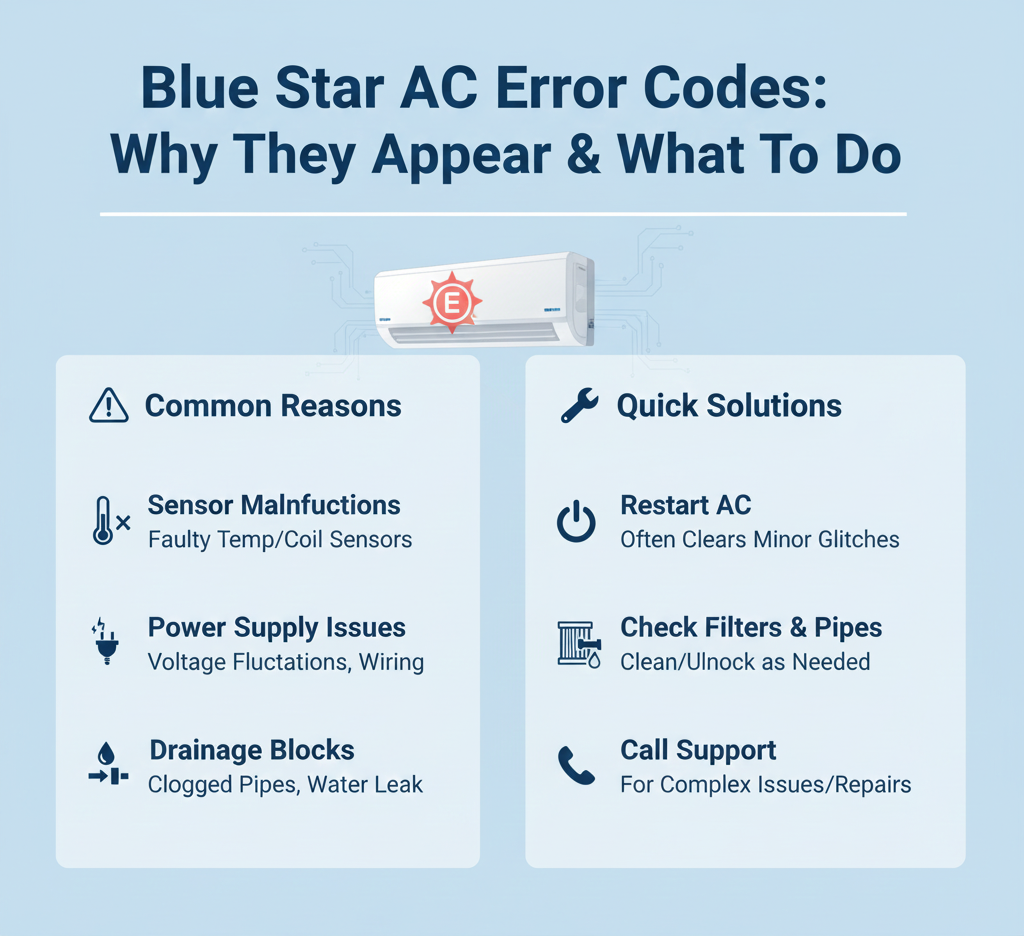
Blue Star AC error codes are not triggered randomly. They occur when the AC notices unusual operating conditions, which may impact the functioning of the device or the components inside it. You could consider error codes as warning lights; this indicates that before the minor problem escalates to a costly fix, the notification comes as a sign to act upon the issue and not allow the AC to operate under the problematic condition when it could be restricted due to it.
Self-Diagnostic System Description
Contemporary Blue Star ACs come with an intelligent self-diagnosis system that checks the health of the critical parts of the AC, including:
- Temperature sensors – in order to provide correct cooling and exclude overheating
- Fan motors – to verify correct airflow circulation
- Compressor Load – to avoid overload or burning out
- Voltage Input – to stabilize the AC from Power Fluctuations
- Communicating between indoor & outdoor units – to maintain smooth coordination
If any of these factors exceed the safe levels, the AC triggers an error code immediately and even turns off automatically, as if it were a safety alarm integrated with the device itself.
Importance of Knowing Error Codes
Understanding the Blue Star AC error code can make a huge difference for you. This will allow you to:
- Minimize unnecessary service calls when the problem is simply clogging filters or voltage fluctuations
- It is essential to be able to quickly spot simple problems that might be solved with just a “reset” or “clean” operation. Sometimes
- Effective communication with service techs, which saves diagnosis time and lowers repairs costs
In conclusion, recognizing error codes gives you the power: less confusion, direct costs, and quick fixes. Knowing is genuinely better than greeting. If you’re facing frequent AC issues beyond error codes, you may also find this guide helpful — check out our detailed article on common AC problems and how to fix them.
Blue Star AC Error Codes according to the Type of AC
“Blue Star error codes use the same self-testing logic in their models,” but the way error codes respond may differ with the AC models. Organizing the error codes according to their respective AC categories makes it easier for the user to identify their problem. Although error codes may be the same, the problem, its display, and the solutions may differ.
Blue Star Split AC Error Codes
Blue Star split AC refers to the most used models in Indian households today. The error codes are normally displayed by the LED panel or digital display of the indoor unit.
Common issues seen in split ACs include:
- Indoor or outdoor temperature sensor malfunction
- Communication errors between indoor and outdoor units
- Fan motor or PCB-related issues
- Gas leakage or refrigerant detection
The Split AC error codes may come in E-series (E1, E3, E5) codes or P-series (P1, P2) codes. While some common errors might be fixed through cleaning filters and resetting, others like communication or compressor errors require professional assistance.
Error Codes For Blue Star Window AC
Window ACs are simpler in design, though error detection protection is provided. Error codes in the Blue Star window AC are expressed by blinking LEDs or by alphanumeric codes. Most of the window ACs of the Blue Star series show error codes by the help of blinking LEDs or by the use of alphab
Typical window ac error triggers are as follows:
- Voltage Fluctuation
- Overheating because of obstructed airflow
- Thermostat or Sensor Malfunction
- Fan Motor Obstruction
Since all the parts are combined in one unit, airflow obstruction and dust buildup are the top reasons for window AC error codes to trigger. Regular cleaning helps to prevent errors from happening.
Blue Star Inverter AC Error Codes
Blue Star Inverter AC units are much more advanced and sensitive; they have continuous monitoring for adjusting cool capacity. The error codes for Inverter models are much more precise and frequent for protecting the compressor.
Some common error categories associated with inverters and AC are:
- Sensor-related errors (F1, F2,
- Compressor Overload Protection
- PCB Communication Failures
- Refrigerant pressure imbalance
Inverter AC units can keep functioning in a reduced capacity mode before shutting down. However, error codes associated with Inverter AC units must be remedied promptly due to the technological complexity involved.
Error Codes on Blue Star Portable AC
“Blue Star” portable air conditioners are quite compact and flexible, yet not without their own set of limitations. The error codes displayed on a portable air conditioner are generally related to environmental and operational factors.
Some of the common errors on a portable air conditioner include:
- Water tank full
- Incorrect exhaust hose installation
- Overheating because of inadequate ventilation Sensor misalignment
Most portable AC error messages can be resolved by yourself by draining the water reservoir, rearranging the exhaust tube, or increasing ventilation in the room. These portable air conditioners can be extremely finicky about settings.
Complete Blue Star AC Error Codes List with Fixes
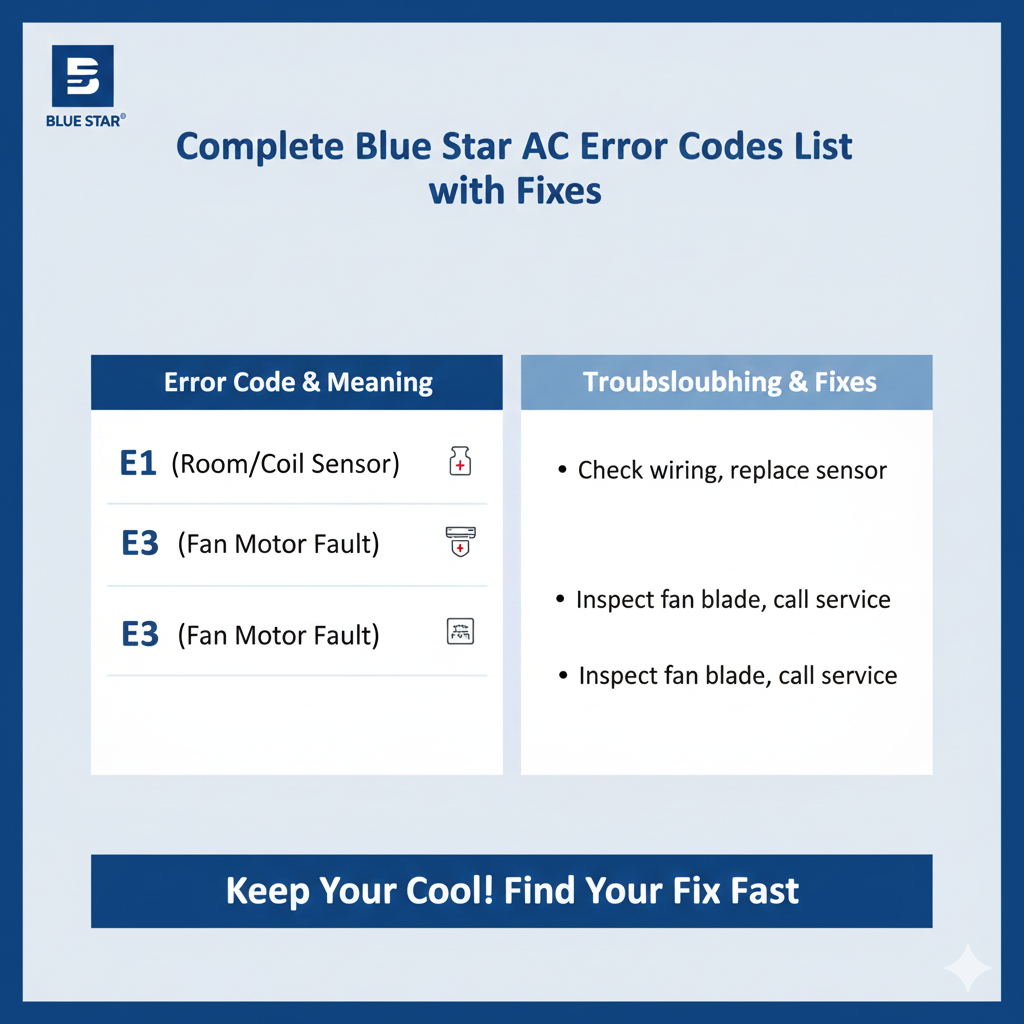
Now, let’s move on to the most important thing
Blue Star AC E1 Error Code – Meaning, Causes & Repair Cost
What Does Blue Star AC E1 Error Mean?
The E1 error code in Blue Star AC stands for the failure of the indoor room temperature sensor.
This implies that the thermistor or temperature sensor in the indoor unit of the AC is either not sensing the temperature or is unable to communicate with the PCB.
As a result, the AC can:
- Stop cooling effectively
- Turn off automatically
- Display the E1 error code continuously on the panel
- Operate but fail to maintain the set temperature
Why Does Blue Star AC Display E1 Error Code?
The following are the most common reasons:
- Loose or disconnected sensor wire
- Faulty thermistor (temperature sensor is damaged)
- Dust accumulation, which affects the sensor reading
- PCB communication error
- Power fluctuation damage
How to Fix Blue Star AC E1 Error Code
Before you call a technician, you can try the following troubleshooting steps:
1️⃣ Turn off the AC using the remote and the master switch.
2️⃣ Let the AC rest for 5-10 minutes to reset the system.
3️⃣ Turn on the AC again.
4️⃣ Clean the air filters of the indoor unit.
If the E1 error code is fixed, it might be a temporary issue. If you’re not sure how to clean them properly, read our guide on AC filters and their maintenance.
If the issue still exists, the indoor temperature sensor may need to be replaced.
Blue Star AC E1 Repair Cost in India
The estimated repair cost is as follows:
| Problem | Estimated Cost |
| Loose connection repair | ₹500 – ₹1,000 |
| Thermistor replacement | ₹800 – ₹2,000 |
| PCB inspection & service | ₹1,500 – ₹3,000 |
Note: The actual cost may vary depending on your location and the type of AC you have.
If your AC is still under warranty, the replacement of the sensor may be free.
Is It Safe to Use AC with E1 Error?
No.
Running the AC continuously with E1 error can:
- Affect cooling efficiency
- Damage the PCB
- Increase repair expenses
It is recommended to resolve the issue early. If your AC is not cooling properly, check this complete guide on why your Blue Star AC is not cooling.
Final Advice
The Blue Star AC E1 error code is usually caused by a faulty or loose indoor temperature sensor. In most cases, the repair is affordable and does not require major component replacement.
If basic reset does not solve the problem, contact authorized Blue Star service for proper diagnosis.
E2 Error Code – Indoor Coil Sensor Error
Meaning:
Faulty Temperature Sensor in Evaporator Coil.
Possible Causes:
- Dust Buildup on Coils
- Sensor Damage
Fix:
- Clean Indoor Coil
- Professional Inspection of Sensors Recommended
E3: Failure of Outdoor Unit to Communicate
Meaning:
Indoor and Outdoor Units Not Communicating:
Possible Causes:
- wiring problem
- PCB fault-It
- Power fluctuation
Fix:
- Check Power Supply
- Reset AC
- Call service if error persists
E4 Error Code – Problem with Indoor Fan Motor
Meaning:
Indoor fan motor not rotating properly.
Possible Causes:
- Fan blockage
- Motor Capacitor Failures
Fix:
- Clean blower
- Fan motor replacement – Service Required
E5 Error Code – Protection Against Compressor Overload
Meaning:
The compressor is overheating or overloaded.
Possible Causes:
- Dirty condenser coils
- Low refrigerant
- High ambient temperature
Fix:
- Clean outdoor unit
- Ensure proper ventilation is provided
- Technician inspection required
If the compressor is damaged due to repeated overheating, check the latest Blue Star 1.5 Ton Split AC Compressor Price in India before deciding whether to repair or replace the unit.
Blue Star AC E6 Error Code – Meaning, Causes & Repair Cost
What Does Blue Star AC E6 Error Mean?
The E6 error code in Blue Star AC usually indicates a communication failure between the indoor unit and outdoor unit.
In simple words, the indoor unit and outdoor unit are not able to “talk” to each other properly.
When this happens, your AC may:
- Stop cooling suddenly
- Outdoor unit may not start
- AC may turn on but shut off after a few minutes
- Display E6 continuously on the panel
This is one of the more serious error codes compared to E1.
Why Does Blue Star AC Show E6 Error?
Here are the most common reasons:
• Loose or damaged communication wire
• Faulty outdoor PCB board
• Indoor PCB malfunction
• Power fluctuation damage
• Improper installation wiring
In many cases, voltage fluctuation is the hidden reason behind E6 errors. For a detailed step-by-step troubleshooting guide, repair cost breakdown, and prevention tips, read our complete Blue Star AC E6 error code guide.
E7 Error Code – Matching Between Indoor and Outdoor Units
Meaning:
There exists incompatibility/mal-association between the Indoor Unit and the Outdoor Unit.
Possible Causes:
- Inconsistencies in indoor and outdoor unit models
- No proper layout for the PCB
- Wrong connection in the wiring
Fix:
- Turn off AC and restart in 5-10 minutes
- Verify that both units are part of the same series
- Contact Blue Star Service for rearrangement or replacement of PCB, if needed
This issue might occur after fresh installs as well as/or PCB replacements.
E8 Error Code – Overcurrent Protection Actuated
Meaning:
It is taking up more current than the safe limits.
Possible Causes:
- Compressor Overload
- Voltage instabilities
- Short circuit in wiring
Fix:
- Turn off the AC at once
- Validate the voltage source and employ a voltage stabilizer, if needed
- Technician is called to check the compressor or wiring
If this error is not attended to, it might result in permanent damage to the compressor.
H1 Error Code – Defrost Mode Activated
Meaning:
The AC has entered defrost mode to defrost the ice forming on the external coil.
Possible Causes:
- Cold weather operation
- Moisture accumulation
- Normally functioning inverter
Fix:
- No action required
- Wait for the Defrost cycle to finish
This is normal protective circuitry and not a problem.
H3 Error Code – Compressor Overheat Protection
Meaning:
“The temperature of the compressor exceeded the safe limits.”
Possible Causes:
- Dirty Condenser Coil
- Inadequate Vent
- Pre-Treatment: Refrigerant
Fix:
- Clean outdoor unit
- There must be proper air flow.
- Scheduled Professional Servicing
Errors Continuing On H3 Indicative Of Serious Cooling System Stresses
L1 Error Code – Power Supply Abnormality
Meaning:
Detected: Power supply possibly instable or false.
Possible Causes:
- Voltage drop or surge
- Loose Electrical Connections
- IMPERFECT POWER SOURCE
Fix:
- Turn off AC and main power supply
- Use a voltage stabilizer
- Home wiring should be assessed by an electrician
This is a problem commonly encountered by regions where there are frequent variations in the power supply.
U4 Error Code – Communications Error (Indoor/Outdoor)
Meaning:
Communication is not possible between the indoor unit and outdoor unit.
Possible Causes:
- Poorly connected or loose communication wires
- PCB failure
- Power Mismatch between Units
Fix:
- Turn on AC after power check
- Verify wiring connections
- if error persist, Call Blue Star service
This sometimes results in cooling failures or sudden system crashes.
P1 Error Code – Voltage Fluctuation
Meaning:
The input voltage is either too high or too low.
Possible Causes:
- Unstable power supply
Fix:
- Use a voltage stabilizer
- In many applications Do not use AC during the hours of maximum fluctuation
P2 Error Code – High Condenser Temperature
Meaning:
The outdoor unit temperature becomes too high.
Possible Causes:
- Uninterrupted airflow
- Extreme heat
Fix:
- Clean condenser
- Improve outdoor unit ventilation
Blue Star AC Error Codes – Quick Reference Table
| Error Code | Problem Area | What It Indicates | Immediate Action |
|---|---|---|---|
| E1 | Sensor | Room temperature sensor fault | Restart AC, clean filters |
| E2 | Sensor | Indoor coil sensor malfunction | Clean indoor coil |
| E3 | Communication | Indoor–outdoor unit not communicating | Reset AC, check wiring |
| E4 | Fan Motor | Indoor fan motor issue | Clean blower |
| E5 | Compressor | Compressor overload or overheating | Clean condenser, ensure airflow |
| E6 | Refrigerant | Low gas or refrigerant leakage | Call technician for gas check |
| E7 | Compatibility | Indoor & outdoor unit mismatch | Verify model compatibility |
| E8 | Electrical | Overcurrent protection triggered | Switch off AC, check voltage |
| H1 | System Mode | Defrost mode active | Wait (normal operation) |
| H3 | Protection | Compressor overheating | Improve ventilation, service |
| L1 | Power Supply | Power supply abnormality | Use stabilizer |
| U4 | Communication | Indoor–outdoor communication error | Check wiring, reset AC |
| P1 | Voltage | Voltage too high or low | Use stabilizer |
| P2 | Temperature | High condenser temperature | Clean condenser unit |
Common Blue Star AC Error Codes in Inverter Models
F1 Error Code – Indoor Ambient Sensor Error
Fix:
Replacing the sensor. Recommended for a professional.
F2 Error Code – Evaporator Temperature Sensor Error
Fix:
Clean coils; replace sensor if required.
F3 Error Code – Outdoor Ambient Sensor Error
Fix:
Outdoor sensor check and replace.
Quick DIY Fixes vs Professional Repairs
When You Can Fix It Yourself
You can try DIY if:
- It is voltage-related
- “Filters are dirty”
- AC requires a reset
It is enough just to clean.
When To Call Blue Star Service Center
Call professionals if:
- Compressor-related errors occur
- There is gas leakage suspected
- Error Persists after Reset
Delaying service can raise repair prices. Here’s a detailed breakdown of Blue Star AC service cost in India to help you estimate expenses.
Error codes one should never ignore are listed below:
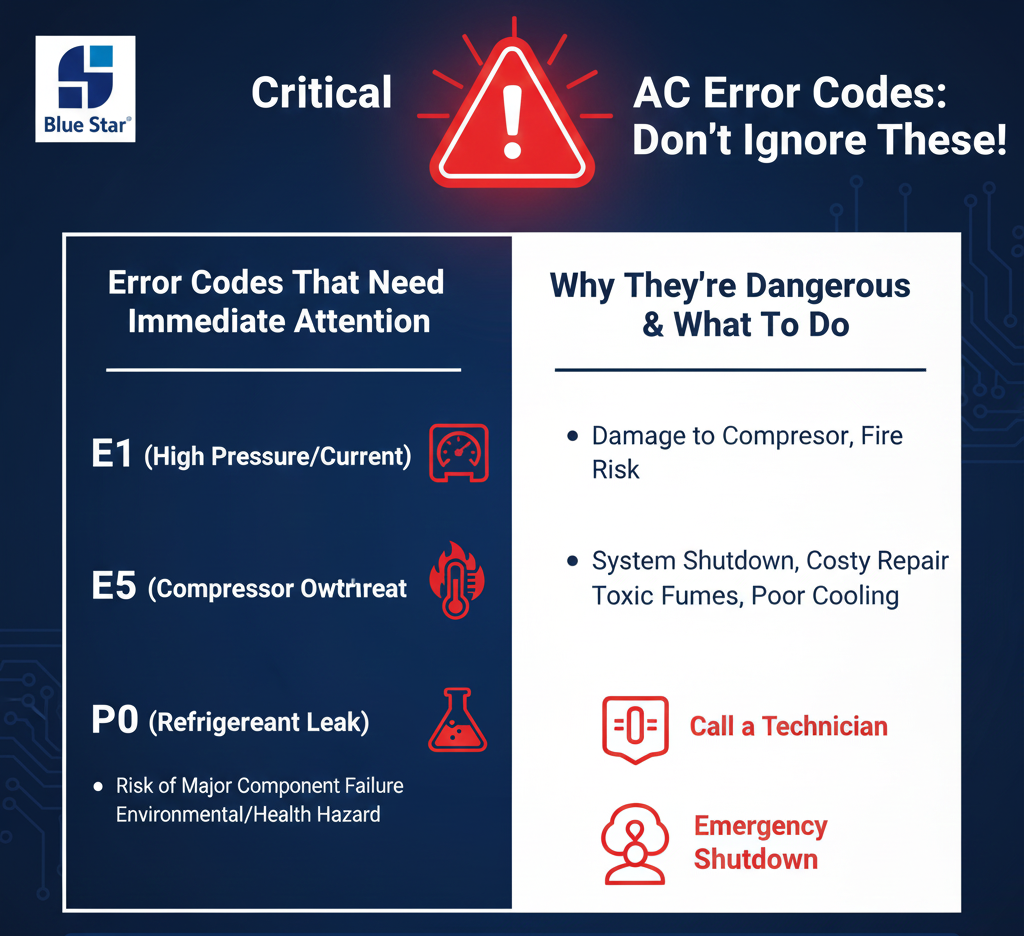
Not all Blue Star AC error codes are the same. Some error codes relate to minor and temporary issues. Others indicate serious issues inside the AC that may cause permanent damage to the AC if not attended to. Identifying which codes require urgent attention will help you avoid repairs and even the replacement of the AC.
These are the key error codes of the Blue Star AC that you must ignore.
E5 – Compressor Overload Protection
This error message flags that the core of your AC unit, the compressor, is under extreme duress.
Why it’s dangerous:
- Compressor Overhe
- Higher level of usage of electricity
- Risk of compressor burnout
What to do immediately:
- Turn off the AC
- Clean outdoor unit if dirty
- Contact a professional technician immediately
E6 – Refrigerant Leakage or Low Gas
If the AC is run when the refrigerant is low, it is much like driving a vehicle without engine oil.
Why it’s dangerous:
- Compressor dries out and overheats
- Cooling efficiency will plummet
- Longer compressor failure rate
What to do immediately:
- Turn off the AC
- Schedule leak detection and gas refilling
- Never do gas refilling by yourself
Gas leakage and compressor overheating are serious issues. For a clear idea of gas refilling costs and warning signs, refer to our complete Blue Star AC gas refill cost guide.
E8 – Over Current Protection Triggered
This is an indication of improper current flow and can be damaging.
Why it’s dangerous:
- PCB damage
- Compressor electrical failure
- Potential electrical hazards
What to do immediately:
- Switch off the AC by turning the main switch
- Don’t keep restarting over and
- Check the wiring and voltage with a technician
Compressor Overheat Protection
That is an indication that the temperature of the compressor has exceeded safety standards.
Why it’s dangerous:
- Thermal stress on compressor
- Shorter Compressor Life
- Sudden system shutdowns
What to do immediately:
- Enhance outdoor unit ventilation
- Clean the Condenser Coils
- Hire experts for servicing
U4 – Communication between indoor and outdoor environments error
This makes it impossible for there to be effective coordination between the indoor unit and the outdoor unit.
Why it’s dangerous:
- AC can malfunction randomly
- Compressor can get wrong messages
- Cooling becomes unstable or ends entirely
What to do immediately:
- Turn off AC
- Inspect Visible Wiring (do Not open PCB)
- Call Blue Star service if error persists
L1 – Power Supply Abnormality
Though common in places with voltage fluctuation, this error should never be overlooked.
Why it’s dangerous:
- PCBs – Compressor Damage
- Repeated tripping and shutdowns
- Decline in the durability of electronic components
What to do immediately:
- Turn off the AC when there is voltage instability
- Employ a high-quality stabilizer Ensure power source checked
Every safety tip is a reminder
if an error code keeps reappearing after resetting it, it is advised not to use AC anymore because repetitive resets force faulty parts of the AC to operate in unsafe ways, thus increasing repair bills.
Rule of thumb:
If the error is related to compressor, gas, power, or communication, it should be handled as an urgent error.
How to Avoid Blue Star AC Error Codes in the Future
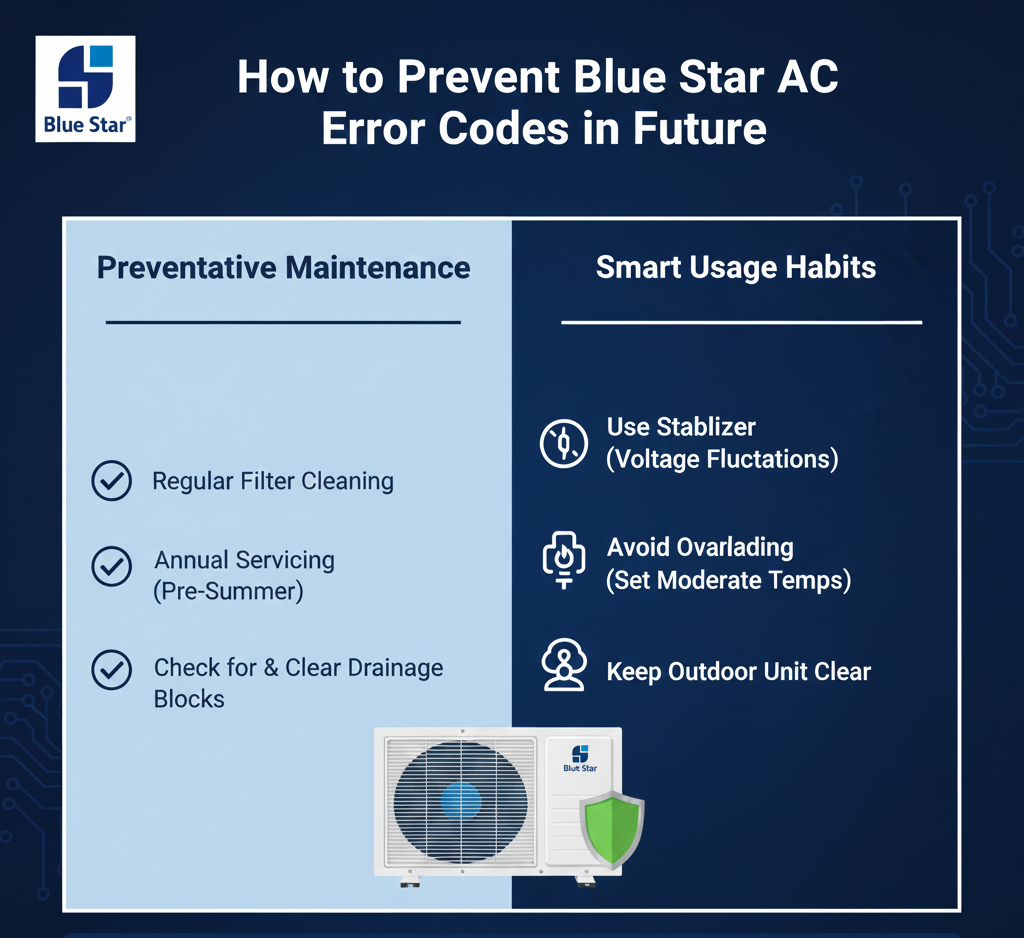
Proper Installation Tips
- Correct Length of Copper Pipe
- Good, tight electrical connections
- Spacing of outdoors should be sufficient.
The better the installation, the lesser the bugs.
Regular Maintenance Checklist
- Clean filters every 2–3 weeks
- Clean the condenser coil.
- Check wiring once every year. Follow these expert Blue Star AC maintenance tips to avoid most common errors.
Annual Servicing Importance
Annual servicing:
- Improvement of the cooling efficiency
- Extends life of the AC.
- Saves them from sudden breakdowns.
It’s like going to the doctor for your AC, checking up on its status.
Voltage Stabilizer & Power Supply Tips
The major reasons for AC error codes on Blue Star are associated with an unstable power supply, voltage, and communication and compressor protection. Even a very good-quality AC is also not able to perform reliably if the incoming power is inconsistent.
Follow these crucial tips to avoid voltage-related error codes and to prolong the life of your AC:
Use a dedicated voltage stabilizer:
If you live in an area where voltage fluctuations are frequent, a stabilizer is a must, not an option. Then choose a stabilizer that contains:
- Correct voltage range (typically 130V–300V for inverter ACs)
- Time-delay protection
- Overload and thermal cut-off features
This helps to prevent errors such as P1, L1, E8, and sudden stops. Also, understand the ideal voltage for Blue Star AC to prevent frequent error codes.
Avoid operating the AC when voltage is too low or too high.
In case of flickering lights or any other abnormal appliance behavior, it will be better to switch the AC off for some time. Continuous operation of AC in unstable power can also trigger protective error codes that may burn the PCB or compressor.
Ensure proper earthing or grounding.
Poor earthing can lead to:
- Communications errors
- False sensor readings
- Repeated safety protection tripping
Always make sure that your AC is plugged into a correctly grounded power point.
AC on a Dedicated Power Line
Avoid sharing heavy appliances such as refrigerators, geysers, and washing machines on the AC power line. Sharing the load on either end of the cable would cause voltage drops because of the cable resistance, resulting in error codes related to communication and power issues.
Check the Quality of Wiring at the Time of Installation
Poor wiring or loose wiring increases the resistance and consequently heat, leading to overcurrent and power errors. Always use
- Recommended wire size
- Very good connectors
- Proper circuit breakers
Quick Tip
Where voltage-related error codes pop up even with a stabilizer, then the problem would not be with the AC itself but rather with either the main power supply or internal wiring. Many Blue Star AC error codes are directly linked to electricity usage and voltage instability. To understand how power consumption and voltage affect your AC, read our Blue Star AC power consumption and electricity saving tips guide.
Stable power means fewer error codes, good cooling, and an increased life for the Blue Star AC.
Conclusion
Blue Star AC error codes are not enemies; they are warning signals designed to save your appliance. Knowing what each code means and how to respond puts you one step ahead of any costly repairs. While some issues can be easily fixed, others need expert care, but at least now you know what transpires behind the scenes.
Keep cool, keep informed
FAQ – Blue Star AC Error Codes List with Fixes
1. Can I reset my Blue Star AC to clear error codes?
Yes, switch the AC off and unplug for 5–10 minutes, and then restart.
2. Are the error codes for Blue Star AC the same for all models?
No, error codes are a little different for every split, inverter, and window AC.
3. Is it safe to use AC when error code appears?
No. It can result in further damage if continuously used.
4. Does low gas always give an error code?
For inverter models, yes. For older ones, it might not be so clear.
5. What is the cost to repair frequent Blue Star AC faults?
Minor issues start from ₹500–₹1,500; major repairs depend upon the parts.